
 DaRmaZat
 Atelier Ryza pushed Gust’s long-running JRPG series into a broader spotlight, and the studio has gradually moved further away from its modest roots. The familiar formula of cozy routines, localized stories, and intimate alchemy gradually made room for larger worlds and more cinematic ambitions. Originally released in 2025 across PC and consoles – including an original Switch version that struggled technically – this review focuses on this week’s new Nintendo Switch 2 release of Atelier Yumia: The Alchemist of Memories & the Envisioned Land.

Walking a Forbidden Path
Rather than introducing alchemist and orphan Yumia Liessfeldt in a quiet fashion, the game opens with a flash-forward in which she is violently confronted and thrown from a cliff by an imposing enemy. Right after, the story rewinds to the beginning of her journey, but that darker tone remains firmly in place.
Centuries after the collapse of the Aladissian Empire, alchemy has become feared and forbidden. The craft itself is blamed for a catastrophe that nearly wiped out civilization, and anyone associated with it is met with suspicion. Nevertheless, accompanied by Viktor, Isla, and a ragtag group of companions including Rutger, Nina, and Lenja, Yumia is tasked with using her knowledge and abilities in a large-scale investigation of the ruins of Aladiss.
Even if the larger narrative never fully capitalizes on its strongest ideas, it sets up an intriguing mystery surrounding Yumia’s identity, the role she will eventually play, and also how everything will unfold after witnessing the introductory cinematic where she seems to be plummeting to her death. However, while the supporting characters and their personal arcs help flesh out the narrative, the same unfortunately cannot be said for the main antagonists, whose motivations receive considerably less attention and lack real depth.


Open Horizons with Quiet Charm
Ironically, despite moving away from the traditional cozy identity, Atelier Yumia still captures a lot of the familiar warmth of the series. Thematically, trails of lingering energy reveal forgotten recipes, hidden stories, and fragments of Aladiss’ history, all while you steadily upgrade your abilities and level up. Instead of undertaking relaxing quests, the coziness can be found here in gathering resources, quietly building and expanding your campsite’s workshops, and spending time in immersive landscapes.
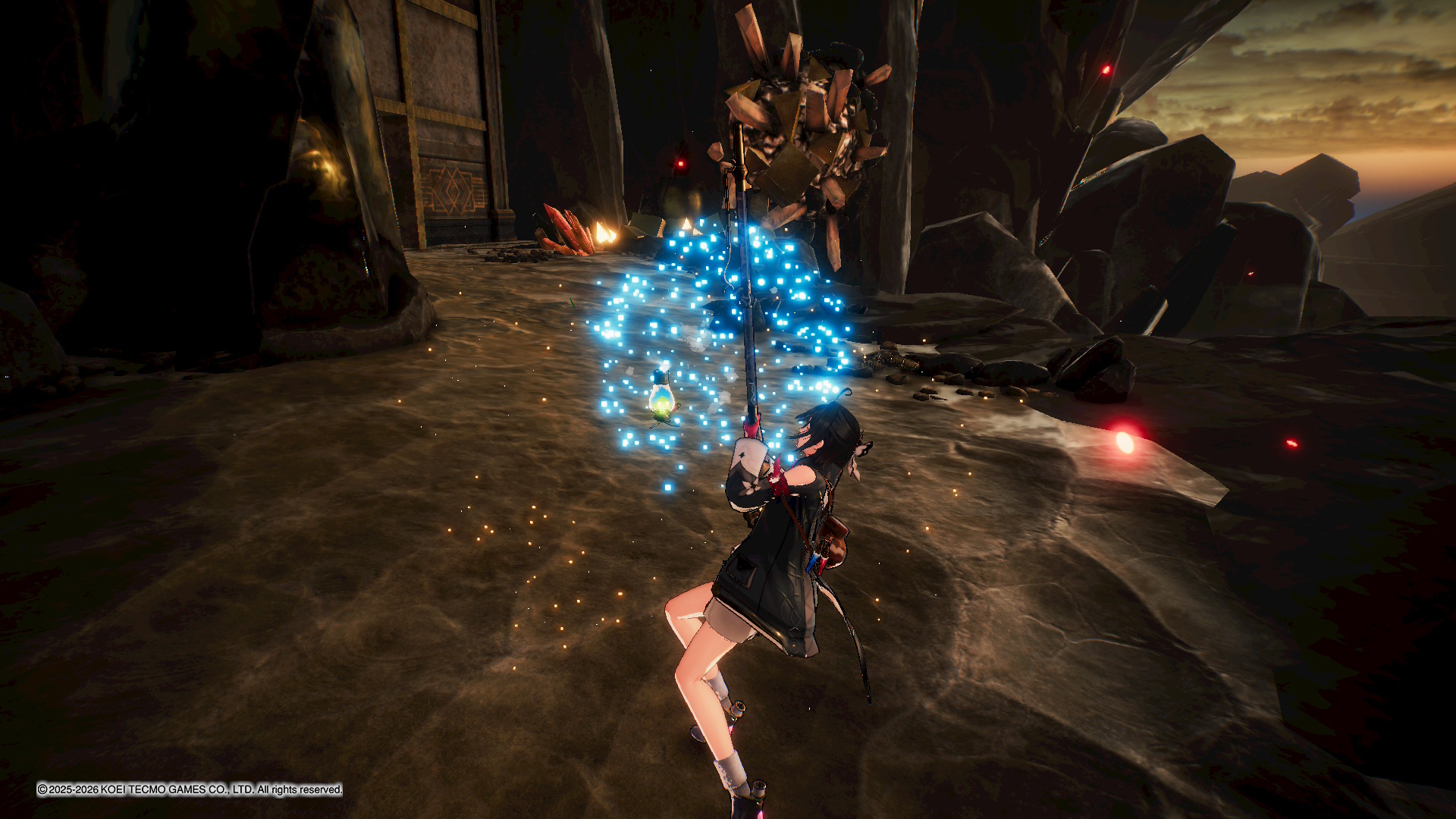
To that end, Gust’s environmental design remains excellent throughout much of the journey, and several areas even leave a stronger impression than the main story itself. That’s because, after the introductory hours, Atelier Yumia fully embraces open-world conventions and removes most restrictions, with large regions encouraging exploration. Climbing, a satisfying wall-adjacent jump system, and the use of ziplines, alongside the later addition of a bike, make simply moving through the world enjoyable, while Yumia’s staff rifle introduces a convenient way to manipulate objects, create new paths, and gather ingredients at range.
At the same time, this grand scale occasionally works against the game. Certain regions feel like rather generic anime-inspired environments or even recreations of each other, and the random quests that constantly pop up to force exploration sometimes clutter the already slow story pacing.


Synthesis Is Doing Fine, Combat Less So
Back on a positive note, Atelier Yumia introduces one of the most approachable crafting systems I have encountered in the series so far. Simple Synthesis allows you to create basic tools directly in the field, while the more advanced projects return to the atelier through the Resonance system. Furthermore, Auto-Synthesis reduces the most repetitive busywork without removing your involvement entirely. This way, crafting rarely becomes exhausting, to the extent that it even feels somewhat optional after a certain point.
This has consequences for the party-based combat, though. Not only is the integration of alchemy into these real-time encounters surprisingly shallow, but the battles themselves – driven by cooldown abilities – can sometimes lack sufficient challenge or a true sense of reward. Your defensive actions, consisting of timed Precision Guards and radial dodges, quickly prove to be extremely forgiving. Meanwhile, underlying imbalances in leveling and enemy scaling can cause your party to rapidly feel overpowered, stripping away much of the tension. As a result, for me, many battles devolved into repetitive ability rotations, alternated with basic attacks, rather than requiring me to think about focusing on the appropriate displayed symbols for enemy weaknesses.
On the audiovisual side, this Nintendo Switch 2 version represents a major improvement in fidelity over the original Switch release, but it is not quite there yet. True, environments now look sharper and draw distances are stronger, yet the current performance issues remain difficult to ignore. Larger zones and busier moments regularly introduce noticeable framerate drops, unfortunately proving that further optimization is still required.


Final Thoughts
What I like about Atelier Yumia is its darker atmosphere, broader scope, varied exploration, and accessible alchemy systems, which successfully give the title genuine charm and a deserved place within the franchise.
That said, however, its combat lacks depth, the villains leave limited impact, and especially, this Switch 2 version falls short of the technical standard expected from an enhanced release. Hopefully, additional optimization can iron out the worst issues, but regardless of the platform, Atelier Yumia: The Alchemist of Memories & the Envisioned Land will likely remain a very niche game: an interesting experiment, rather than a defining Atelier entry.
Additional Information
Release Date: June 9, 2026
Reviewed On: Nintendo Switch 2. Download code provided by the publisher and PR agency.
Developer: KOEI TECMO, Gust
Publisher: KOEI TECMO
Relevant links: Available via Nintendo eShop (BE, NL, US) and Steam.


