DaRmaZat
 Vampires have always occupied a special place within dark fantasy. They embody supernatural powers and fragility at once: immortal rulers bound by legacy, ancient codes, and hunger for blood. That unconditional fascination is clearly shared by players, as Vampires: Bloodlord Rising has already surpassed 200,000 wishlists on Steam ahead of release, while access requests for the playtest are still open.
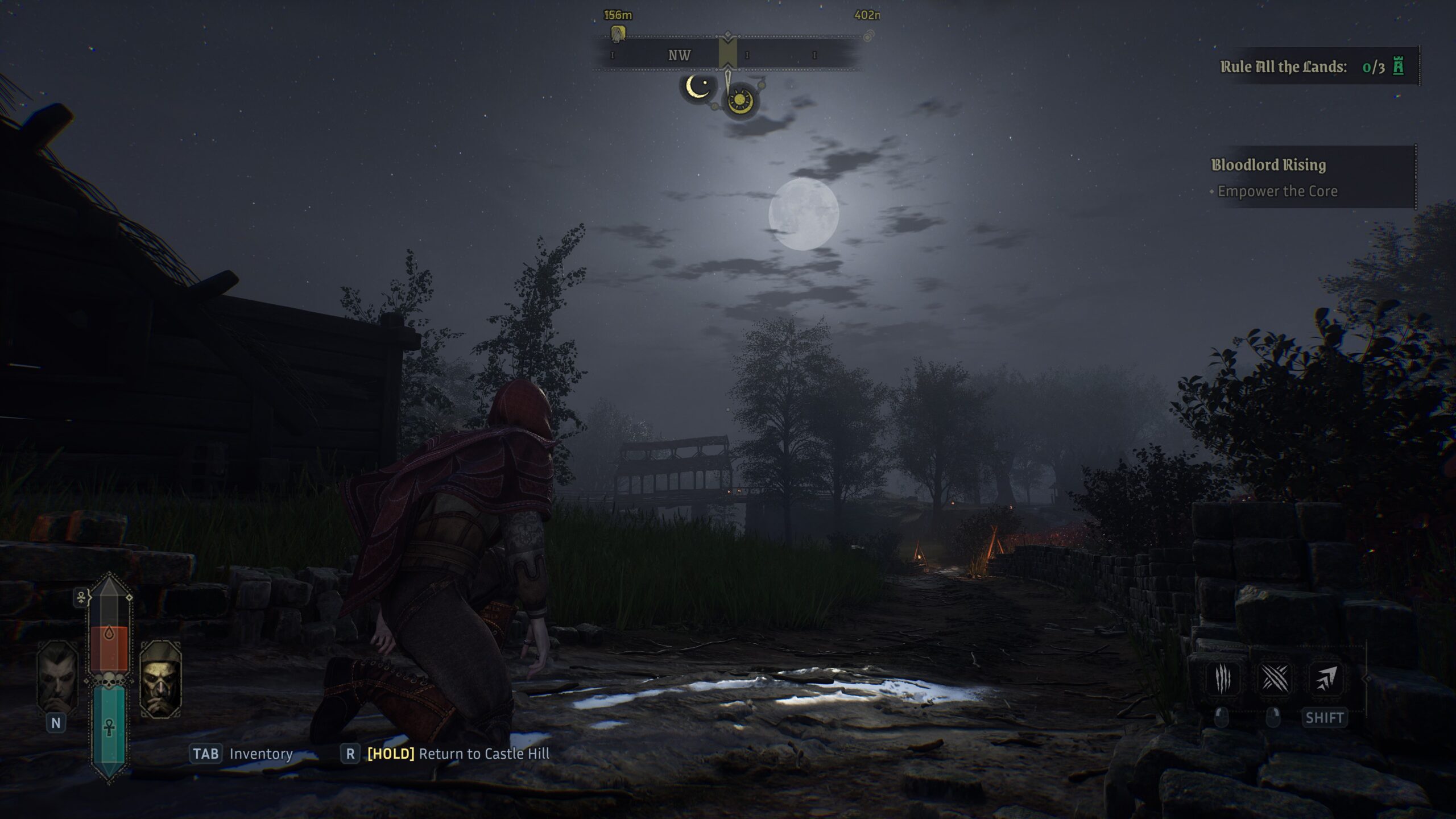
Developed by Mehuman Studios and published by Toplitz Productions, Vampires: Bloodlord Rising enters Early Access on January 30. Set in Sangavia, a grim medieval land inspired by Balkan folklore, it blends survival, crafting, building, sandbox progression, and narrative choice into the fantasy of carving out your own vampire dominion.
Awakening Into Someone Else’s Legacy
Somewhere deep within Sangavia lies Medresti, a region that feels as if it is slowly losing its last line of defense. For years, the Silver Veil—a thick, supernatural mist intentionally cast by magicians to keep vampires and other demonic creatures out to protect humankind—has been failing. With the veil weakening more and more, everything that was once driven underground by the Inquisitors begins to crawl back, eager to reclaim territory and torment whatever still dares to live there.
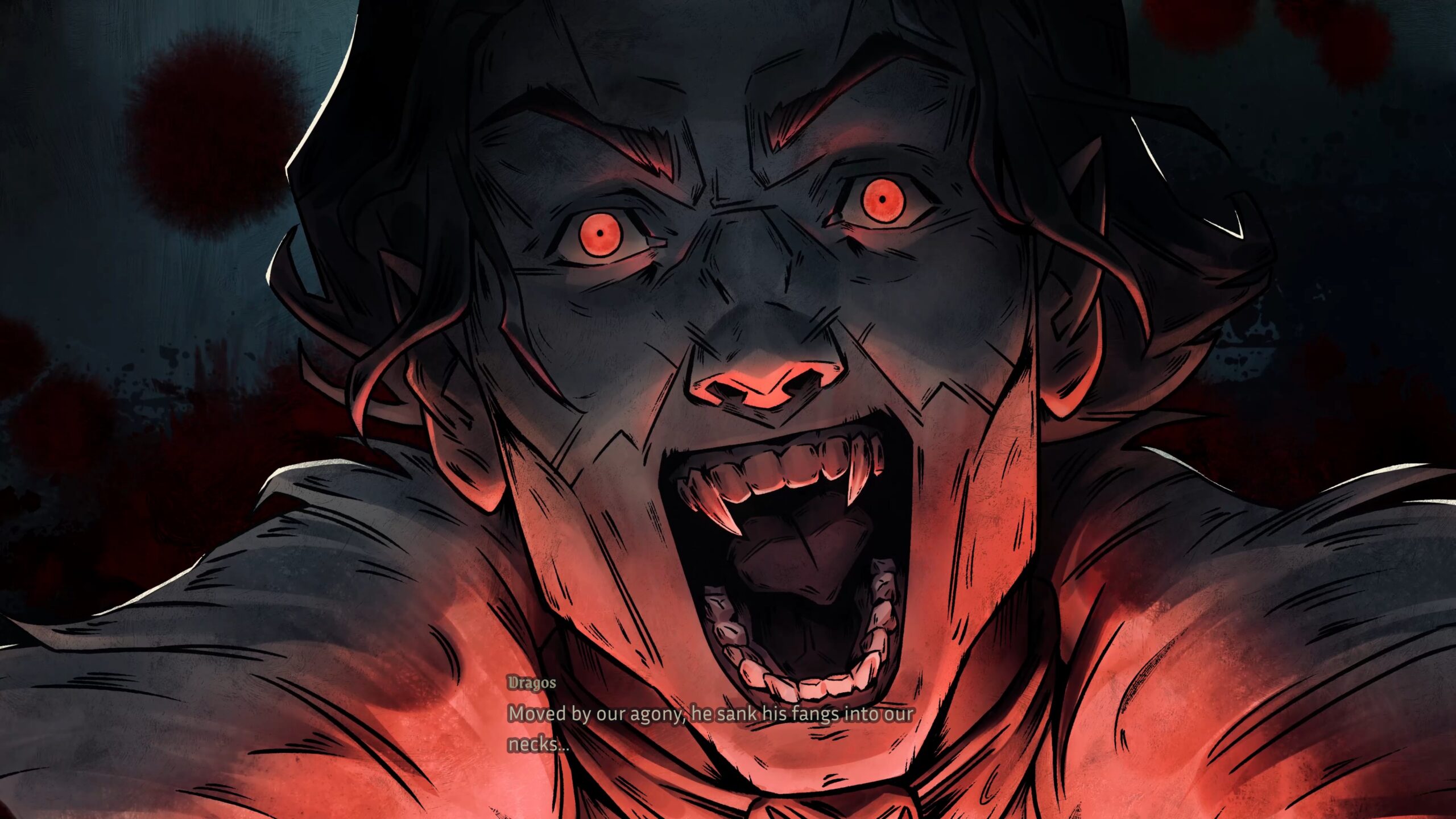
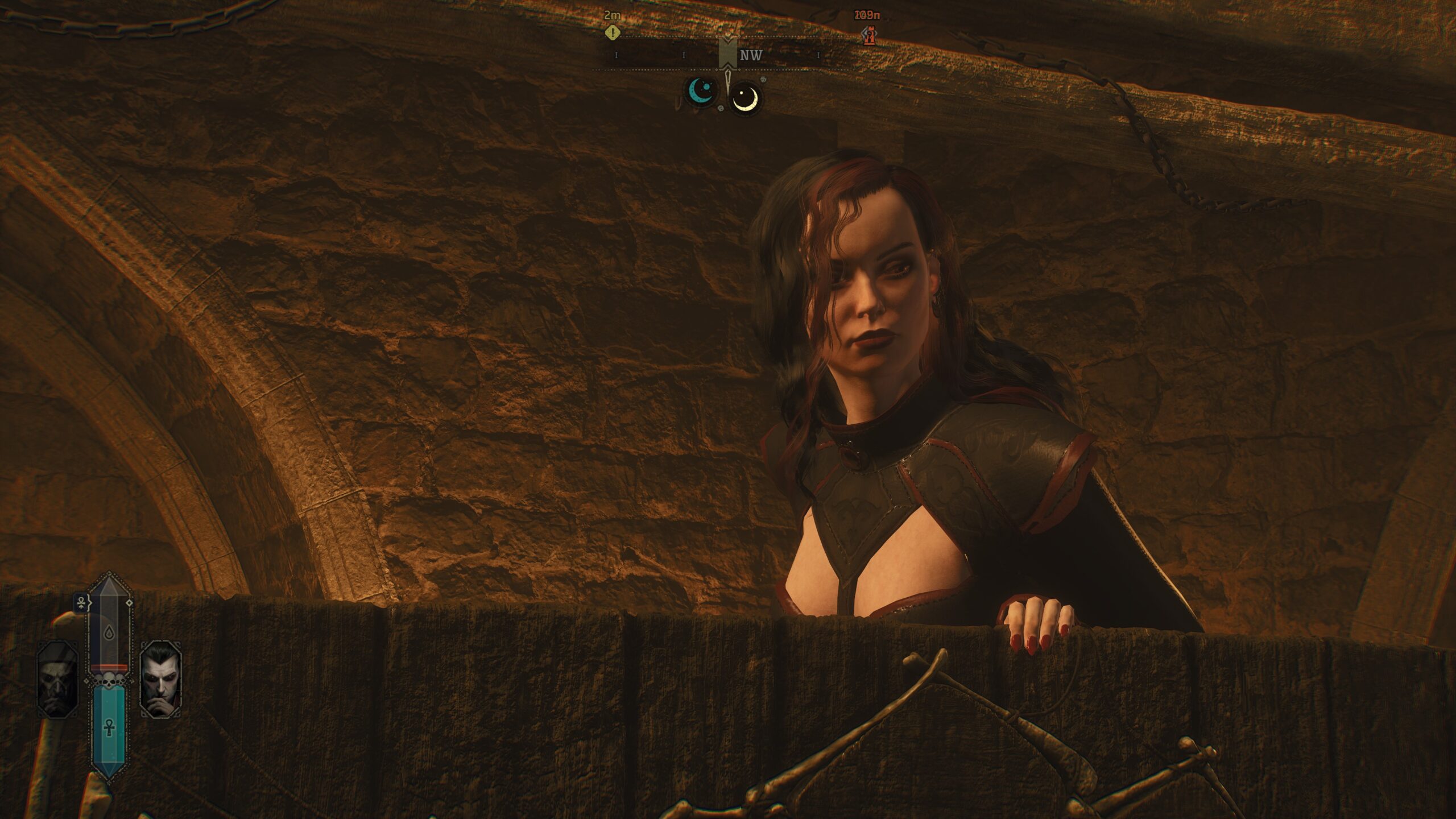
So too are you. Dragged back into existence by the voice of your master Vorago, you awaken as the vampire Dragos. Not as a hero, but as a tool, standing at the threshold of power with a clear command: restore the Blood Core and rebuild Vorago’s shattered legacy. To get started, Razvan, your older brother and fellow vampire, acts as narrator and advisor, delivering the initial plot beats and laying out the stakes.
Restoring an Empire, One Region at a Time
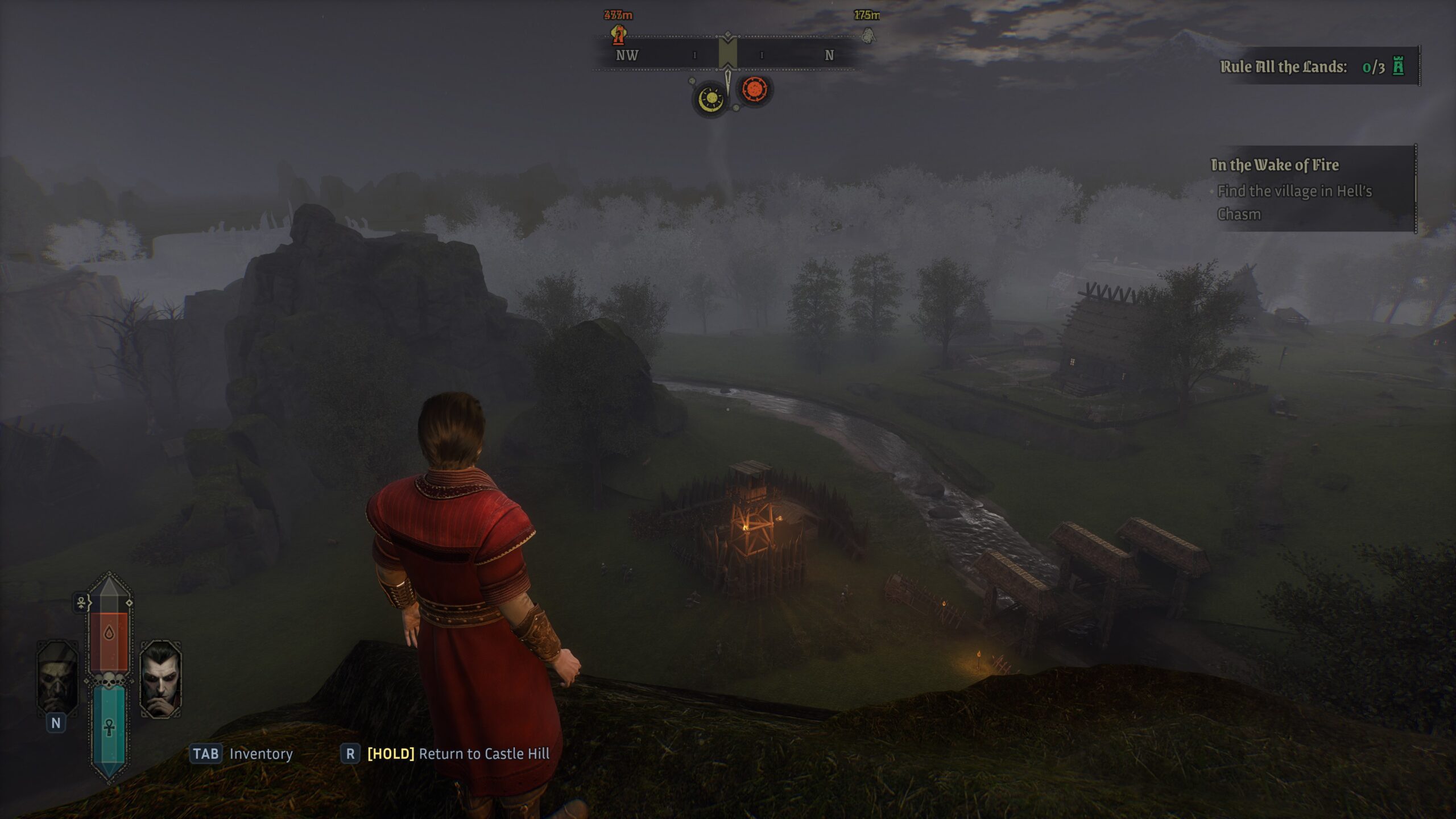
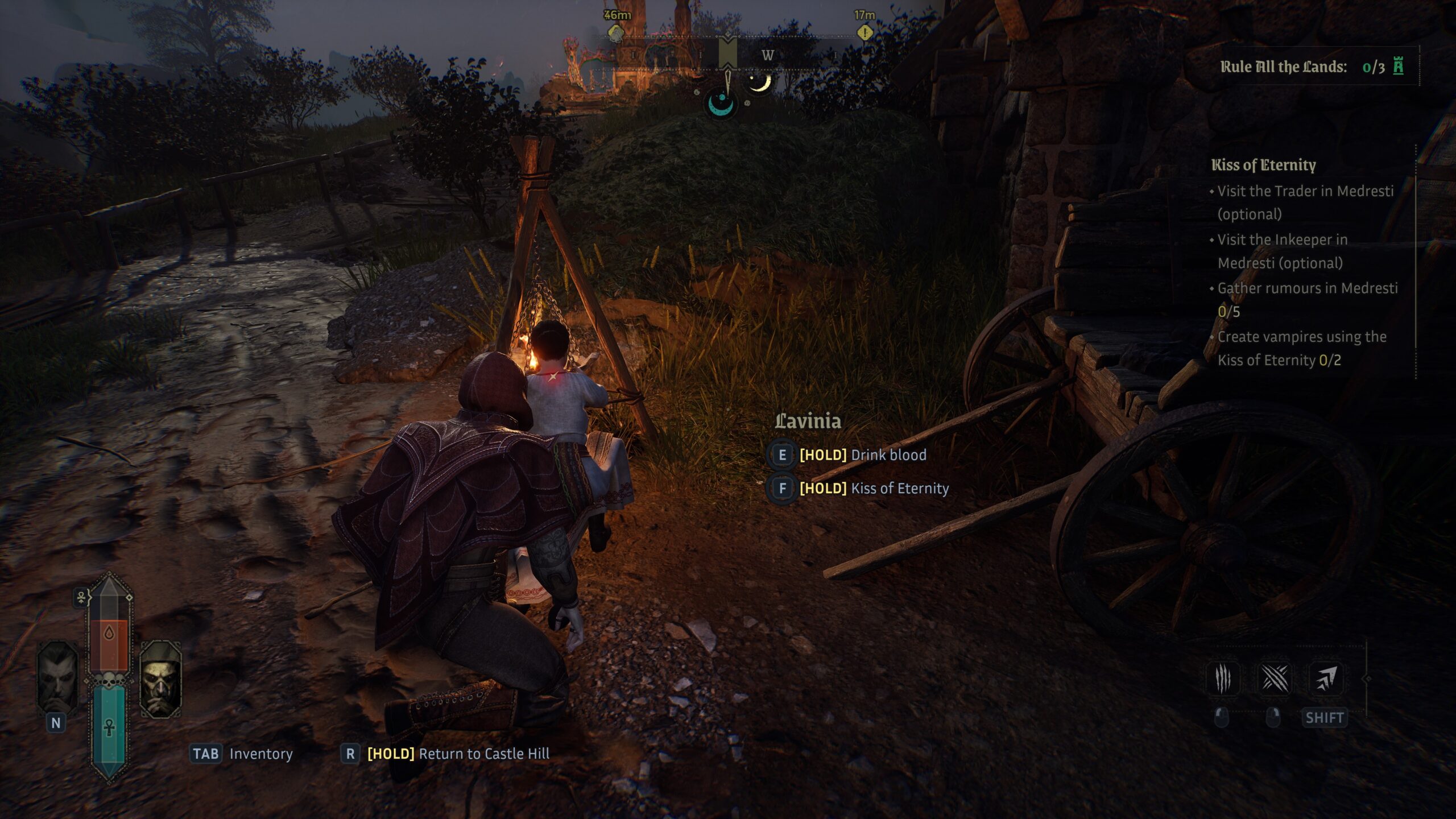
Through Razvan’s explanation, the game immediately makes one thing very clear: this is not a personal redemption story, but the reconstruction of an entire vampire order scattered during the Inquisition. Since being hunted and driven apart by inquisitors, old allies have vanished, strongholds have fallen, and trust has eroded. Collecting vampire servants as your workforce—by biting them—and tracking down former allies (some may already be willing, others might need convincing) becomes one of your first tasks. You’ll need to travel to each corner of Sangavia, region by region, village by village, to re-establish power and belief in the return of the legacy Vampire order, by placing Strongholds and assigning allied vampires as delegated rulers.
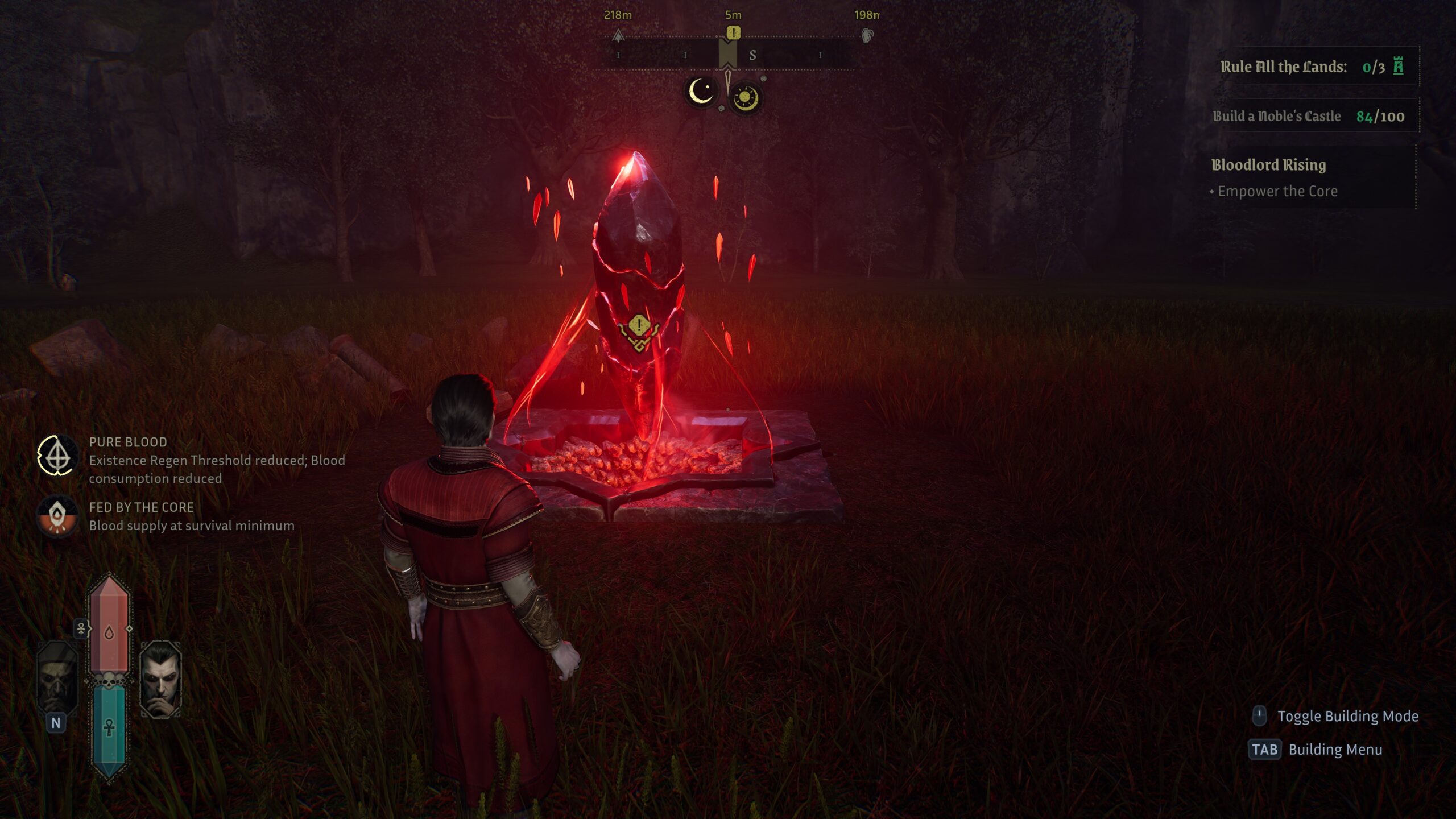
Each base you build turns into an autonomous hub, through which you can trade resources to strengthen your own position, with the Blood Core at its heart. Feeding it with blood is required to progress the game’s main mission. Reaching certain blood-level thresholds unlocks new features, opens additional regions, and expands your influence. Once you have strongholds in another region, teleportation between zones using the Blood Core also becomes available. Truth be told, the entire setup strongly recalls V Rising, from tier-based progression to construction systems tied to blood levels, though the heavier narrative framing helps it feel more immersive.
Build, Craft, Manage
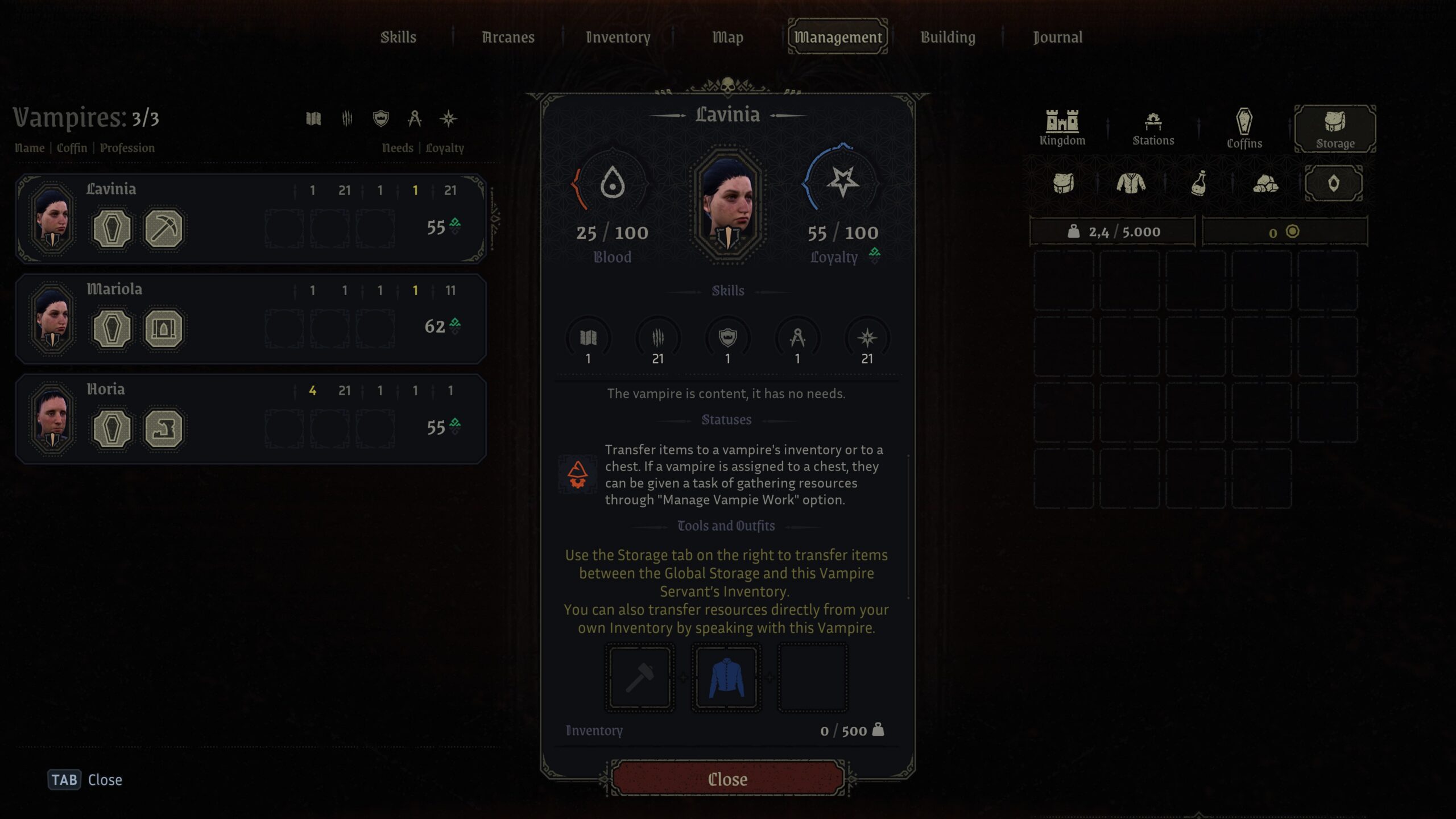
Of course, before any empire can rise, learning to survive together takes priority. With dawn posing a constant threat, Dragos’ first task is building one or multiple Crypts for his servants. Each crypt can house multiple coffins to shelter your workers from sunlight. Storage chests can also be placed here, functioning as a resource pool shared between you and your clan, and you can also share items through direct conversation.
Managing your servants becomes a mini-tactical game in itself. Their loyalty to you, their lord, must be maintained by meeting their needs. Neglect them, and they complain first, then leave. Each vampire servant requires both a coffin and assigned duties within your kingdom. I quickly noticed that newly turned servants always spawn at the same nearby location outside your crypt. Their models clipping together into what looks like a multi-headed monster is unintentionally hilarious, but also a clear reminder of Vampires: Bloodlord Rising’s Early Access roughness.
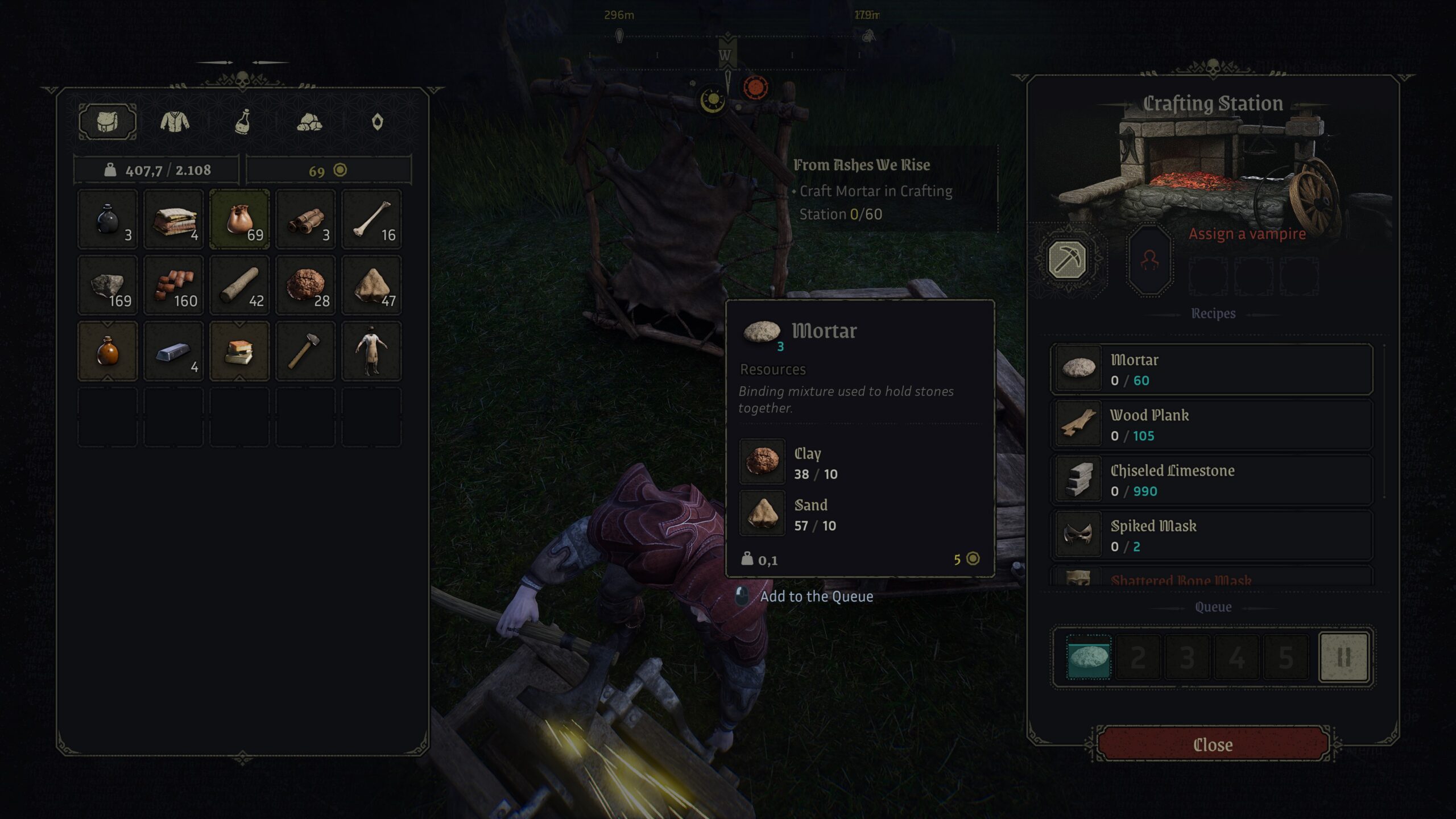
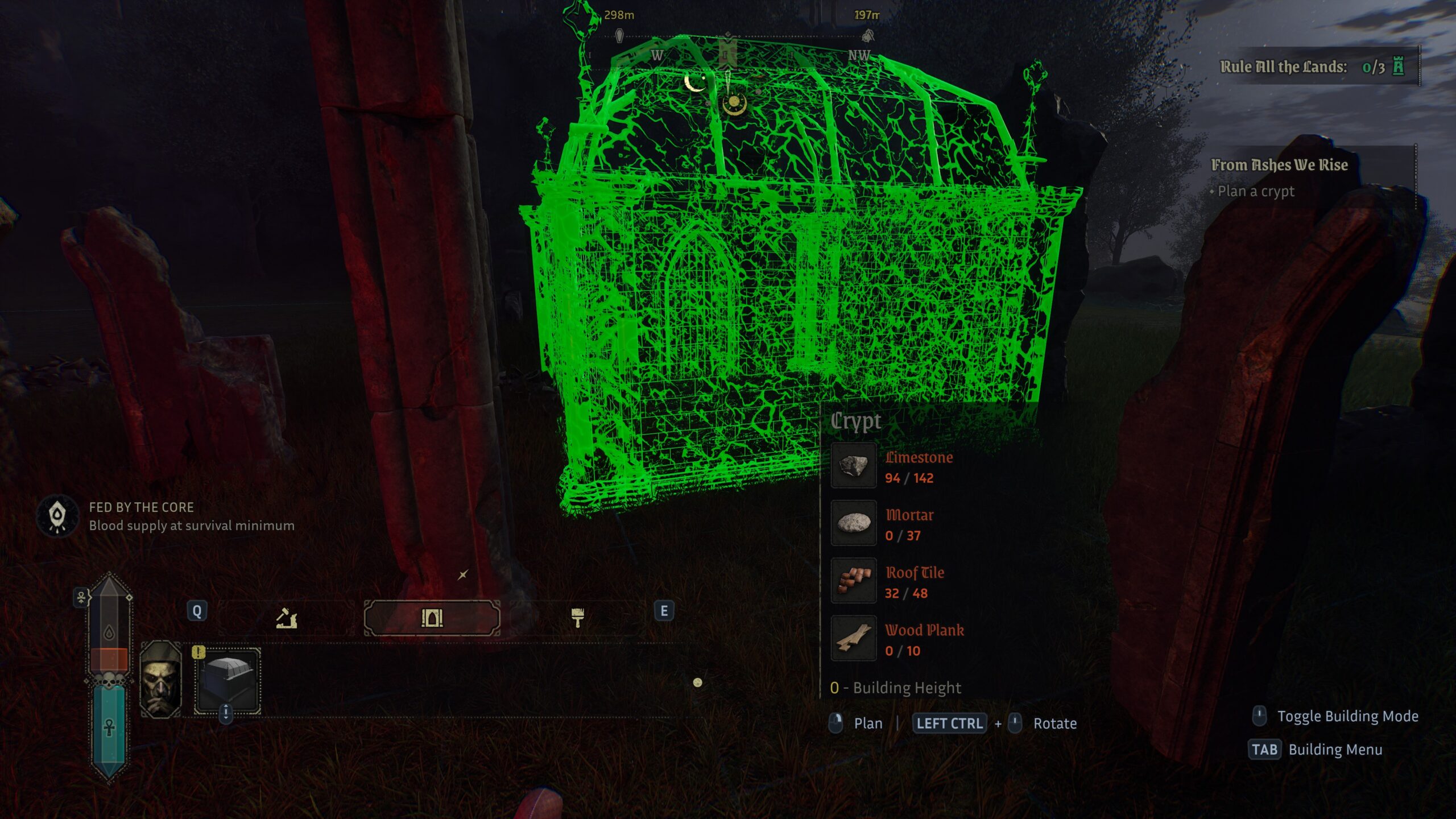
Building constructions begins by switching into build mode and placing blueprints to reserve space on the map and see which materials—limestone, roof tiles, mortar, etc.—are required. Gathering resources is initially manual, but once gathering stations are built and assigned to a servant, it happens automatically. One oddity is that construction only begins after gathering or crafting all required materials, which feels strange since structures are then assembled piece by piece anyway.
Crafting has a similar quirk. Once started at a crafting station, production continues indefinitely, putting base resources in until manually stopped via the UI. Being unable to predefine exact quantities makes resource management a bit clumsy. Adding to this, the inventory interface visibly flickers when material counts update. Nevertheless, both building and crafting mechanics are fun and engaging, and easily among the game’s strongest gameplay elements so far. They’re not hard to figure out, and most resources are easy to find in the nearby environment.
Blood, Skills, and a Dash of Strange Logic
Dragos is not just a normal vampire—he can shapeshift, switching between his initial Hunter and Aristocrat forms. As a Vampire Lord, he looks more human, allowing him to blend into human populations and interact without immediate danger—unlike the Hunter form, which requires stealth or fleeing when noticed. However, the game explains that each form has drawbacks. For example, feeding on blood is only possible in Hunter form. Why a Vampire Lord cannot drink blood—or even bite—remains oddly irrational.
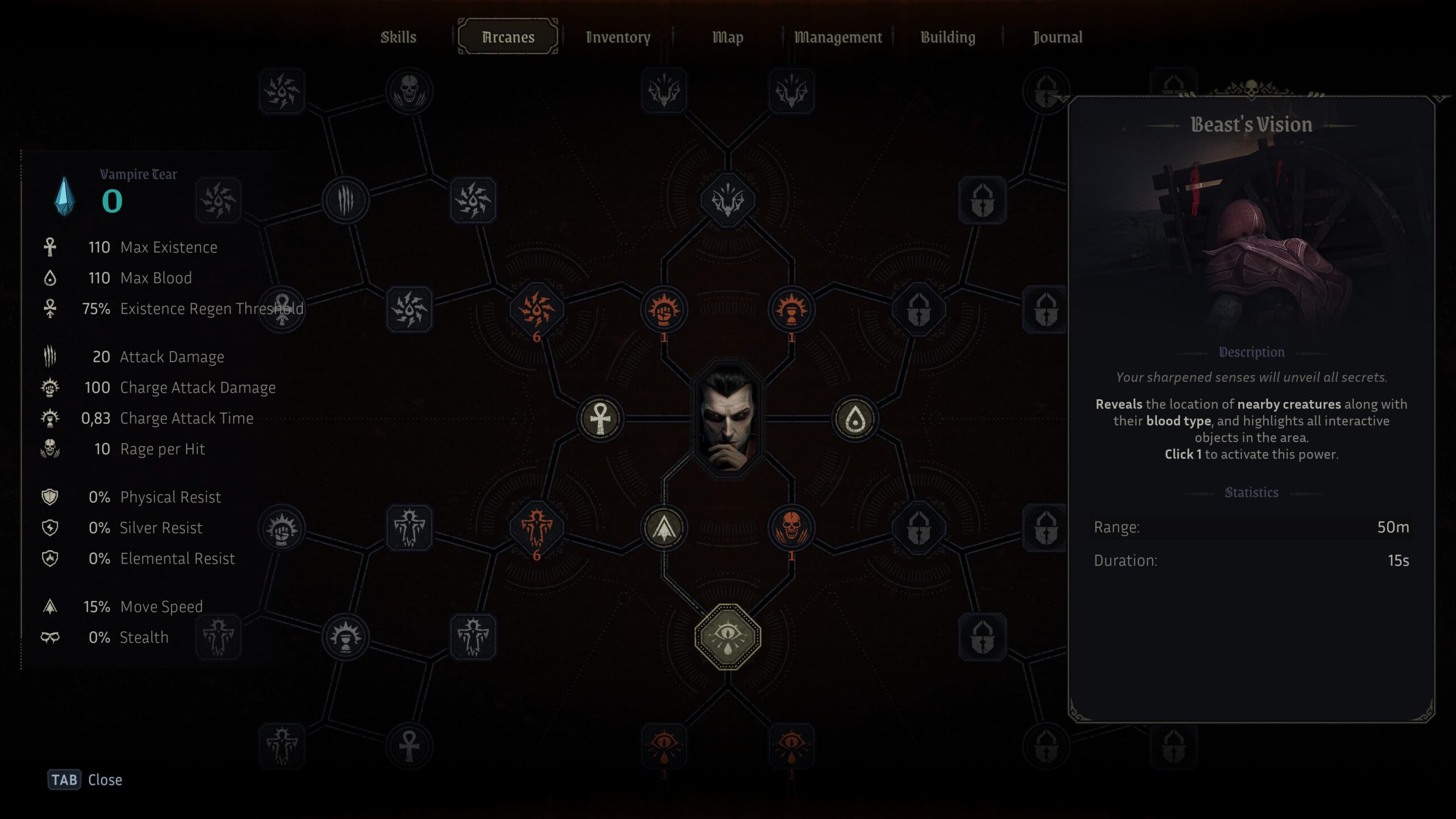
That said, fortunately, your character can expand in interesting ways as you progress by conquering inquisitor camps and collecting Vampire Tears. These unlock Arcane skills in a dedicated tree, tied to useful special abilities. Beast Vision, for example, highlights creatures with blood, helping prevent panics when your blood gauge is near zero.
Sunlight pressure is another constant concern. The HUD shows the time of day, and before dawn you must return to a coffin. Therefore, the fast travel option back to your base is helpful. Upon death, you respawn in the last visited mausoleum with a coffin in the basement. Still, submerging from the sun is not always reliable; sometimes Dragos starts to burn even in a pitch-dark cave. Since when is a vampire not safe in a cave during the day?
A Fight with Teeth and Nail
Another element worth discussing is combat in Vampires: Bloodlord Rising. At this point, it feels very rudimentary. Without dodges or rolls, encounters rely on light attacks, charged strikes, and occasional finisher animations triggered by momentum.
When multiple enemies attack at once, fights quickly become chaotic. Still, there’s a certain scrappy charm in the amount of improvisation you can apply during what I call “the most hectic fights ever between humans and an immortal”—using terrain, spacing, and frequent charge attacks while jumping like a mad kangaroo, rather than relying on precise button presses for timed parries or combos, as we’re used to in modern games.
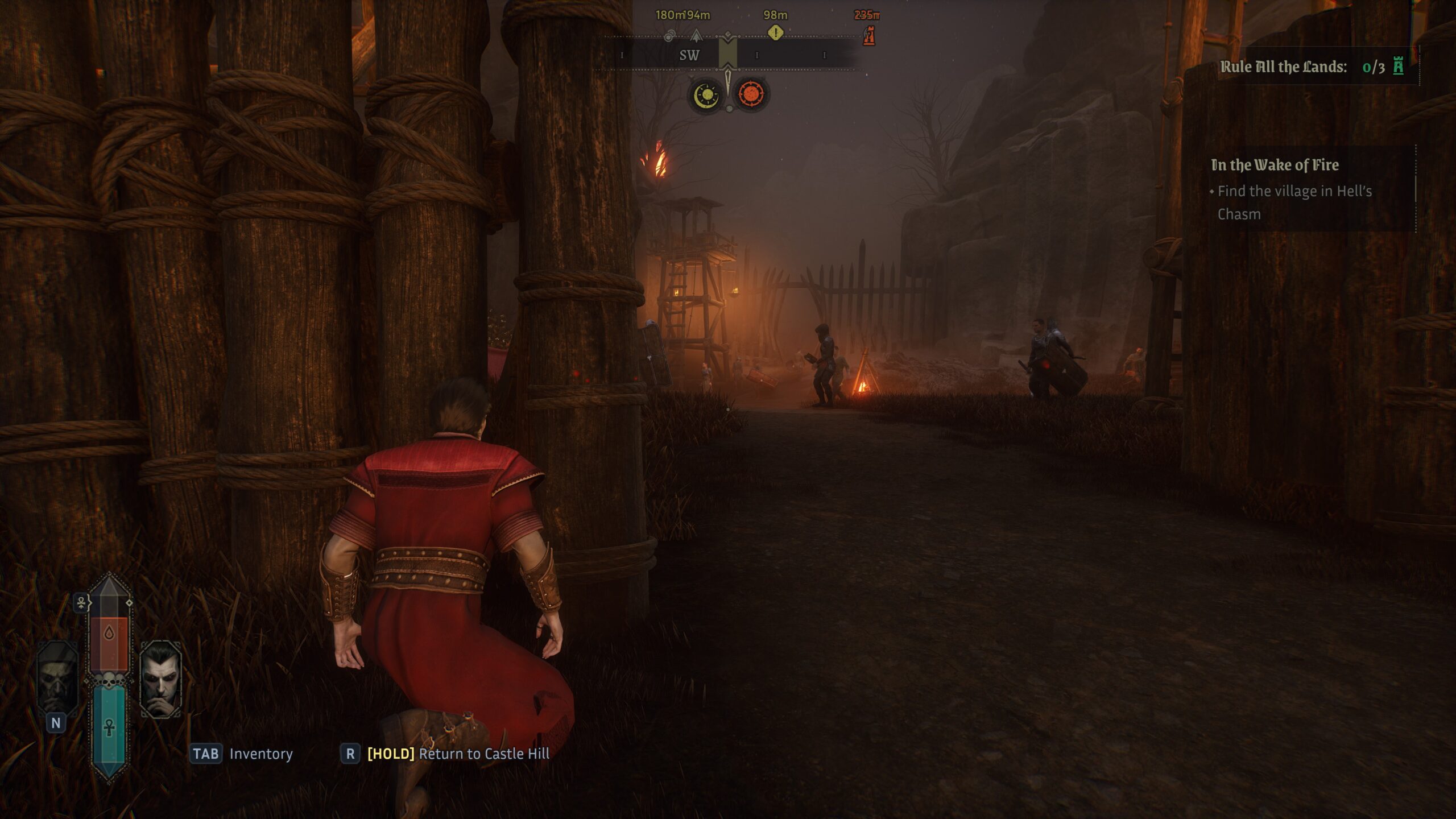
The enemy AI is also too inconsistent for well-organized fights. Their pathing often follows heavily scripted routes, and sometimes they get stuck or disengage entirely when you crouch in plain sight.
Early Access’ Technical State
Surprisingly, especially because Vampires: Bloodlord Rising is running on Unreal Engine 5, performance is smooth. That said, technical issues abound. Key bindings can break after visiting control menus. Dragos may remain stuck in a crouched position until switching forms. Rotating the camera can make ground or walls vanish briefly. Quicksave and quickload are missing, which feels illogical, as manual saving is always available, and loading is slow.
Audio also needs work. While voice acting is solid, neither Dragos nor NPCs animate their mouths during dialogue, and drained victims sometimes continue speaking after death. Intro music leaves little impression, but the in-game soundtrack maintains atmosphere effectively, sounding oppressive in the right ways.
Preliminary Thoughts
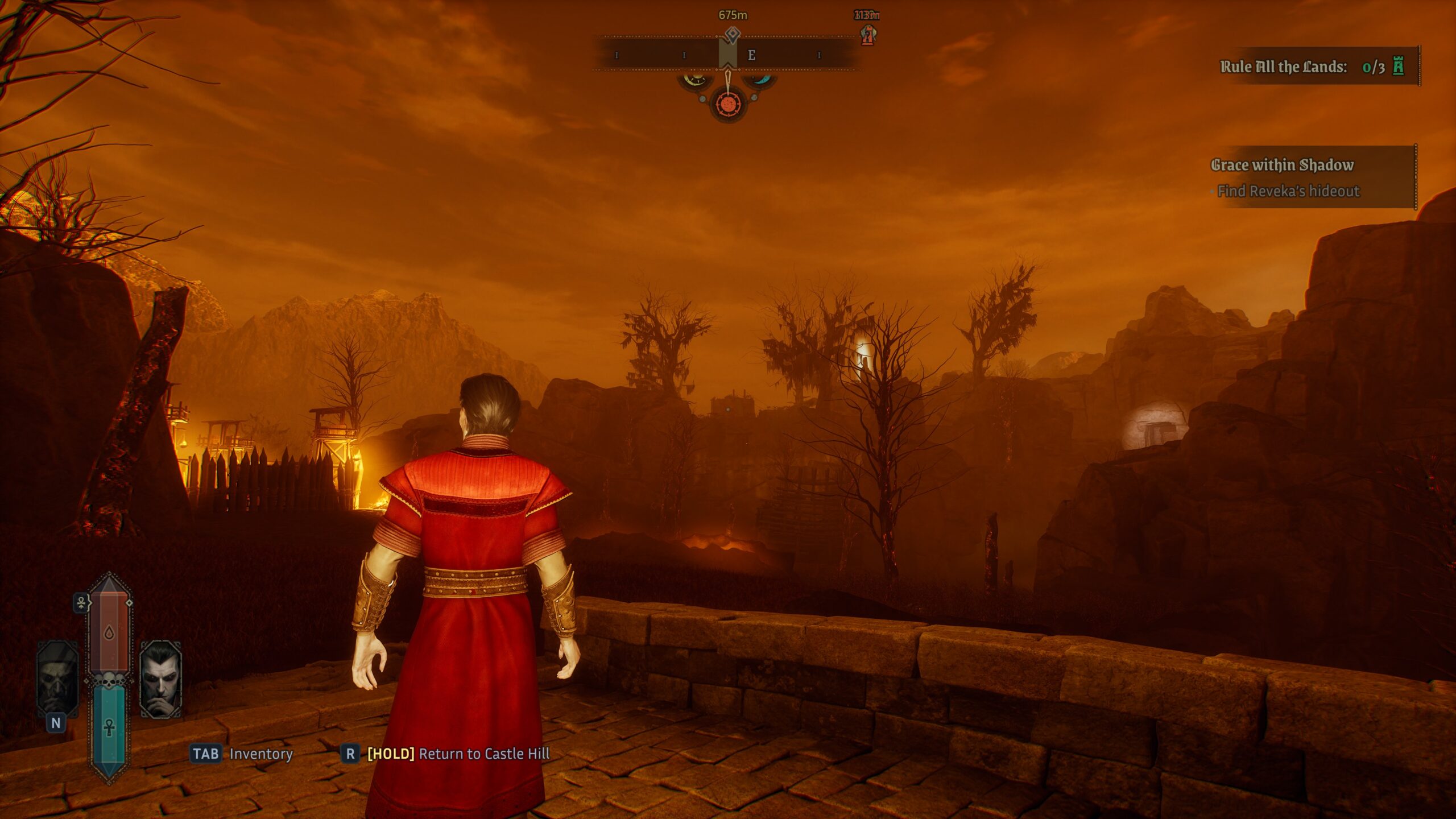
There is no denying that Vampires: Bloodlord Rising still requires a significant amount of polish. Systems clash, explanations arrive late, and technical seams are visible throughout. Yet beneath these issues lies a solid foundation. Base building and servant management are genuinely addictive. Expanding regions and watching your vampire dominion grow carries real appeal. Sangavia’s scale and its distinct regions make exploration worthwhile, even in its current state.
As Early Access continues, more world content, story, and lore are planned—and the existing framework feels capable of supporting that growth. Vampires: Bloodlord Rising is not there yet, but its ambition is unmistakable. It already feels fun to play, whether solo or with friends.
Additional Information
Release Date: Jan 30, 2026 (Early Access)
Previewed On: PC. Download code provided by the developer and publisher.
Developer: Mehuman Games
Publisher: Toplitz Productions
Website: Toplitz Productions
Relevant Links: Vampires: Bloodlord Rising on STEAM