DaRmaZat
 To kick things off, a confession right off the bat: I have never played any of the original Fatal Frame games. But in case it wasn’t clear by now, I have a major soft spot for Asian (horror) games. The entire DreadOut series is also very close to my heart, where—as I previously discussed at length—you likewise have to confront lingering ghosts while also tracking traces of past spirits, all with a camera at the ready. Fatal Frame II: Crimson Butterfly Remake, on Switch 2 no less, seemed right up my alley. The underlying lore, the grim setting, the eerie atmosphere, the graphical overhaul: I was all set to flash those ghosts into oblivion. Turns out things went a little bit differently, though.


A Sisterly Bond Under Strain
The plot begins with two twin sisters, Mio—whom you control—and Mayu, the older one. After a moment that exposes their bond, including their habit of holding hands, the world around them suddenly turns pitch black. Mayu starts acting weird, almost as if she’s under a spell. It is especially disturbing symbolism for the threats awaiting them in Minakami Village, better known as the Lost Village—a godforsaken place where gruesome things happened in the past.
Once you arrive, the intrigue keeps building through handwritten notes referencing missing persons, but also hands that shouldn’t exist ending up on your shoulder. In other words: it’s haunted as hell. And then there is that mysterious crimson butterfly that seems to want to show you the way. But where to? Eventually, the drama comes to a head when Mayu goes totally erratic and runs away, after which you give chase to find her at all costs.


Camera Obscura, Quite Literally
Before this climax takes place, you have already learned to bring invisible ghosts into view and destroy them via the flash of your Camera Obscura. This camera is compatible with all sorts of film rolls that each have their specific purposes but also their downsides, depending on the type of enemy you are facing. Indeed, going further than I dared to expect, this Fatal Frame actually requires you not only to know the application of your film types and filters by heart, but also the different types of ghosts—Wraiths, Specters, Revenants, Vanishing Spirits, … Let’s just say a good memory comes in handy, unless you like reading through the extensive documentation.
That same theoretical complexity naturally extends to the practical combat mechanics. With the—albeit upgradable—camera aimed at a spirit, you not only need to maintain control over your lens focus, zoom gradation, and charge, but at the same time, you have to try and get as many red spots in the frame as possible. Based on the lights, you have to time your shot for the best chance at a Shutter Chance—basically the momentum for flash salvos when the enemy gets staggered. Meanwhile, your Health and Willpower gauges are flickering like crazy, and every dodge or escape attempt once the spirits manage to down you has a direct impact on your stats for the rest of the fight. Because, it must be said, the generally messy battles often drag on in an old-fashioned, endless way. You try to cleverly counter a ghost trying to grab you with a flash, after which, depending on your aim and timing, the ghost only loses a tiny bit of health.


Remake or Refined Remaster
Admittedly, I certainly had my problems with combat quirks in the launch version of Fatal Frame II: Crimson Butterfly Remake, even in Story Mode. However, I can somewhat reassure you that since the recently released patch, the combat balance has been fine-tuned in your favor, meaning the ghosts lose a bit more health if you manage to pull off the perfectly executed so-called Fatal Frame shots. Still, the combat feels clunky, and even the available lock-on or the game options to make the chaotic events a bit smoother and more stable don’t seem to change much. The game regularly feels more like a remaster than an actual remake from the ground up. Luckily, there are lanterns around every corner where you can save the game.
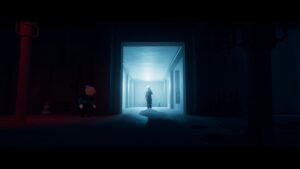
Even though the graphics look properly spruced up by modern standards and the framerate runs quite smoothly on Switch 2—both docked and handheld, especially with that recently launched handheld mode boost option—this Fatal Frame II remake is quite linear and monotonous in terms of environment and exploration. This is also reflected in the rest of the gameplay. Typical for the genre, tasks often consist of finding keys or objects for progression, while meanwhile, you capture all sorts of apparitions on film, often without much gameplay reward.
Every now and then, I noticed some glitchiness or flickering, like clothing or even Mayu herself rotating during the hand-holding, but otherwise, it is a pretty bugless experience. Cutscenes can be paused neatly, and the sound design doesn’t disappoint in terms of atmosphere with its many creepy noises like squeaking doors, creaking stairs, your distorted Spirit Stone Radio, and those constantly wailing ghosts in the background.


Final Thoughts
Fatal Frame II: Crimson Butterfly Remake is a game that undoubtedly divides even long-time fans of the franchise. On one hand, the graphics were hugely polished in terms of fidelity and the game runs super smooth even on the Switch 2. However, under the hood, you clearly feel that many other aspects remained untouched, which makes the experience feel a bit uneven. Less remake than remaster, yet there is fun to be had for the true horror fans who will gladly take the old-school mechanics—with the clunky combat at the center—in exchange for the eerie atmosphere that this remake successfully establishes.
Additional Information
Release Date: Mar 12, 2026
Reviewed On: Nintendo Switch 2. Download code provided by the publisher and PR agency.
Developer: Koei Tecmo
Publisher: Koei Tecmo
Relevant links: Available on Nintendo eShop (BE, NL, US)