DaRmaZat
 Hell Is Us finally released on September 4, delivering a third-person action-adventure that blends exploration, melee combat, and punishing, mind-bending puzzle-solving across a semi-open, war-torn landscape. What begins as a daring mission soon escalates into a gritty journey that tests observation, patience, and persistence in equal measure.
Hadea, A Bleak Calamity-Stricken World
You play Rémi Letam, an ON Peacekeeper voiced by Elias Toufexis—best known as Adam Jensen in Deus Ex—whose stoic performance highlights a protagonist so emotionally detached he sometimes feels absent. Going AWOL to return to his devastated homeland of Hadea in search of his parents, Rémi finds himself caught in a country fractured by war and scarred by the Calamity, a mysterious disaster that unleashed alien, ghostlike entities immune to conventional weapons.
The atmosphere of Hell Is Us leans heavily on its civil-war backdrop. Beyond the shattered landscapes, the narrative dares to confront darker themes—references to sexual abuse and violence toward children punctuate the brutality, grounding the conflict in more than just ruined scenery. Both religious factions, the Palomists and Sabinians, embody the endless cycle of human cruelty, echoing the game’s core theme that war is less about demons and more about mankind’s own destructive instincts. It’s a pitch-black notion the game’s title itself postulates, without any detours.
While the worldbuilding undoubtedly carries weight—showing the aftermath of executions and survivors grappling with the consequences of war crimes—some interactions feel far lighter, often coming across as filler or existing solely to support the many puzzles. The dialogue can feel clumsy at times, echoing what the visuals already convey, while revisiting characters frequently triggers obsolete lines that no longer align with your progression. The protagonist’s stoic silence—Rémi picks up a fallen ally’s sword, armor, and drone without a single word—amplifies an impression of lifelessness, while at the same time, the setting and lore scream to be dug deeper into. In other words, sadly, the writing sometimes undermines the immersion created by the game’s otherwise haunting setting.


Swords, Axes, Polearms and …
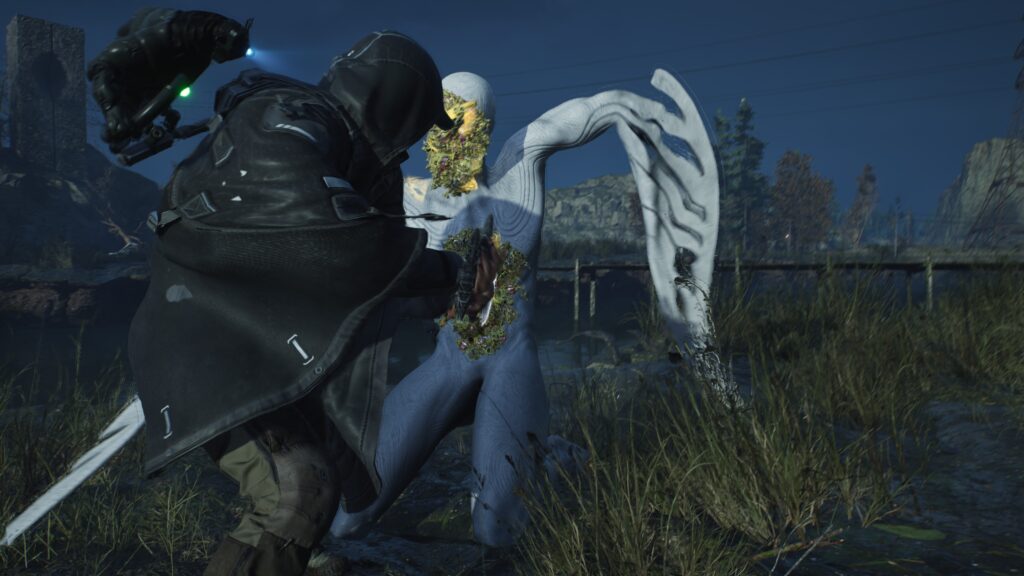
Hell Is Us features a melee combat system we’ve seen before, but at least it functions as intended. Light and charged attacks, dodges, parries, and timing-based ripostes form the backbone, with a secondary weapon for added variety. Glyphs and relic powers—including the Healing Pulse, which restores health if you press the button in time while chaining hits without taking damage—expand tactical options, and the upgrade system using Lymbic Shards further enhances your arsenal. The scalable difficulty makes the game also approachable for a wider audience. Or, in other words; at its core, this is not a soulslike. Meanwhile, the accompanying drone aids you in combat by distracting enemies, scans the environment during puzzles, and provides other utility functions.
Yet combat often feels inconsequential, perhaps unsurprisingly, as it is largely overshadowed by the puzzles. It’s never truly engaging and quickly exposes its lack of depth. For Rémi, traversal is equally restrictive—no jumping, climbing (beyond ladders), or vaulting, and a single misstep into deep water is fatal. Enemy variety is also limited, with only a handful of true boss fights, and death carries almost no penalty: dying even restores health—making it sometimes advantageous to conserve your medkits—along with stamina and items. Enemies do not automatically respawn; whether they return depends entirely on the last save point and the optional “Death Penalty” setting. Consequently, grinding for Lymbic Shards to upgrade weapons at Victor’s shop can leave you overpowered, with few or no enemies remaining to test them on.
… Lots of Riddles
As noted, puzzles dominate the experience, often disrupting the game’s flow. Expect to memorize codes, hunt for distant artifacts, and backtrack through linear areas guided almost entirely by memory to make even a small amount of progress. Some of the riddle challenges are clever and rewarding, but others feel tedious or unfair. With limited side paths and many mandatory main puzzles, the pacing harshly punishes impatience—sometimes almost tricking you into skipping actions in the so-called Good Deed system—essentially a euphemism for fetch quests.
Technically, Hell Is Us performs admirably, with a smooth framerate and decent combat animations. The game’s sound design enriches the grim, war-torn atmosphere with numerous eerie noises, even though the soundtrack is nothing special. Graphically, the game can feel dated at times, with some abrupt cutscene animations and older character models during face-to-face dialogue, but overall the presentation is polished and stable, with only occasional stutters in certain locations.


Final Thoughts
Hell Is Us is an ambitious and atmospheric experience that leans heavily on exploration, puzzles, and environmental storytelling rather than combat, however omnipresent the latter may be. Its world is visually compelling, and the unique “no-map” design initially creates a sense of discovery. However, at times, writing, AI, and certain mechanics feel half-baked, and linear progression, limited replayability, and repetitive side quests reduce long-term engagement.
Nevertheless, players who appreciate methodical problem-solving and dark lore, will find much to admire in Hadea’s grim landscapes. The game tests patience and observation, rewarding those willing to delve into its cryptic, mid-war universe.
Additional Information
Release Date: Sep 4, 2025
Reviewed On: PC. Download code provided by the publisher and PR agency.
Developer: Rogue Factor
Publisher: Nacon
Website: Hell is Us
Relevant links: Hell is Us on Steam