DaRmaZat
 The world’s most foul-mouthed goblin is back in Styx: Blades of Greed, and this time, he’s answerable to no one. Nine years after his last outing, Styx returns in a prequel that bridges the gap to the Great War and the formation of the Black Hand. By trading linear levels for sprawling, vertical open worlds, Cyanide attempts to evolve its cult-classic formula, though the technical execution often feels like it’s stuck in the past. Yet, beneath the rough exterior, the heart of a master thief still beats strong!

Crashed in the Slums and It’s Not for Crumbs
Blades of Greed‘s story kicks off on the Iserian Continent with a daring heist as Styx swipes a massive chunk of Quartz from a giant golem. After a spectacular crash, Styx and his skeptical crew—including pilot Helledryn and the elf Djarak—find themselves stranded in the Slums. After completing one of the initial stealth missions, Styx acquires his own airship from Irving, a drunkard of a captain. This smaller, more agile vessel serves as a mobile hub and fast-travel station where you can interact with your band of outcasts and plan your next move. What follows is a dark fantasy narrative centered on the hunt for Quartz, a dangerous energy source that the badass Priest Geoffroi and his Inquisition are using for their own diabolical ends.
Throughout this journey, Styx remains his classic self: a grumpy, foul-mouthed anti-hero with a vocabulary that leans heavily on F-bombs, providing a gritty yet often hilarious contrast to the high-stakes drama.

Vertical Ambition vs. Rigid Controls
The game is built around three massive, vertically-inclined maps: the urban sprawl of The Wall, the swampy Turquoise Dawn, and the ruins of Akenash. To navigate these immense and often confusing layouts, Styx now utilizes Metroidvania-style progression. New traversal upgrades like the grappling hook and paraglider are essential, as they unlock previously unreachable areas and hidden relics.
While these tools aren’t exactly reinventing the genre, for Styx, they are a godsend—mostly because the base traversal is so hit-or-miss. Without these upgrades, your sense of wonder is constantly undermined by the rigid controls. It’s frustratingly common to see Styx refuse to grab a ledge within arm’s reach or stutter against a platform edge for a split second before plummeting into the abyss. In a game that relies so heavily on precise parkour, these technical glitches turn every jump into a high-stakes gamble. This is further complicated by an often uncooperative camera. Hiding in a closet or crawling under furniture offers such a narrow and awkward field of vision that you’ll only do it when there’s absolutely no other choice.

Stealth Complemented by a Wide Range of Supernatural Stuff
If the movement and perspective feel like a relic of the past, the stealth mechanics are a masterclass in modern player agency. Where Blades of Greed truly shines is in its “freedom of approach”. Before diving into a mission, you can craft essential tools like potions, acid to dissolve bodies, or traps using resources like larva and ore found in the world. Once inside, you are given a wide array of creative stealth options: peering through keyholes, dousing torches with sand-filled spitballs, or even vomiting toxic bile into a guard’s food to eliminate them without a sound. That’s where the fun really started to hook me.
“Where Blades of Greed truly shines is in its freedom of approach.”
Your tactical options are expanded by a mix of old and new: classic abilities like invisibility and cloning still rely on your Amber Gauge (and the potions needed to refill it), while the new Quartz powers, such as Time Shift and Mind Control, add a more potent layer to your supernatural arsenal. Whether you’re managing your meter or timing a cooldown, these tools allow for some creative solutions to the game’s tougher stealth puzzles.
If your stealth fails, however, prepare for a headache. Combat is miserably sluggish and clearly best avoided at all costs. The game is transparently not built for open confrontation, doubling down instead on its stealth-first identity. The requirement to manually arm your dagger with an analog stick press before you can even swing is an outright clunky design choice—one that feels almost intentionally obstructive to punish you for being spotted. Additionally, while you can save manually, the game only permits it when you are completely “safe”. On top of that, even the automatic checkpoints are notoriously unreliable, often failing to trigger if enemies are lingering nearby.

A Grim Beauty with Technical Quirks
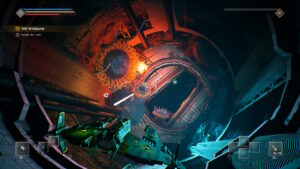
Visually, the Iserian Continent is a striking blend of dark fantasy and industrial grime. While the actual in-game environments are atmospheric and rich in detail—bolstered by an excellent musical score that captures the tension of a high-stakes heist—the overall presentation is a bit of a mixed bag. The character animations remain a bit stiff, and cutscenes are sometimes marred by texture pop-in.
“A striking blend of dark fantasy and industrial grime.”
The game supports modern bells and whistles like upscaling and Frame Generation, but even without them, it maintains a high framerate throughout the more complex, vertical areas. That said, this smoothness comes at a cost: the game insists on compiling shaders between every single level. While it’s an annoying hurdle that briefly breaks the pacing, it effectively eliminates in-game stuttering.

Final Thoughts
Is Styx: Blades of Greed flawed? Absolutely. Between the stiff animations, glitchy parkour, and the erratic camera, it often lacks the polish expected of a 2026 release. But is it fun? For fans of challenging stealth, yes. The funny, slapstick nature of the kills and the variety offered by your upgrades ensure the game delivers on its core promise: a gritty, rewarding adventure with a protagonist who always finds a way to come out on top. It’s a solid recommendation for anyone who loved the previous games or lives for the tension of a Dishonored-style sandbox.
Additional Information
Release Date: Feb 19, 2026 (Early Access via Quartz Edition: Feb 17, 2026)
Reviewed On: PC. Download code provided by the publisher and PR agency.
Developer: Cyanide Studio
Publisher: Nacon
Relevant links: Available on STEAM