DaRmaZat
 When I stepped onto the board as a demon “made of glass and pain”, I immediately felt that Skate Story was carving out its own identity—one that leans as much into allegory and surrealism as it does into physics-driven movement. Sometimes Skate Story genuinely moved me; sometimes it pushed me to the edge of frustration. However, above all, the game struck me as singular, more specific in a way that was equal parts exhilarating and disorienting.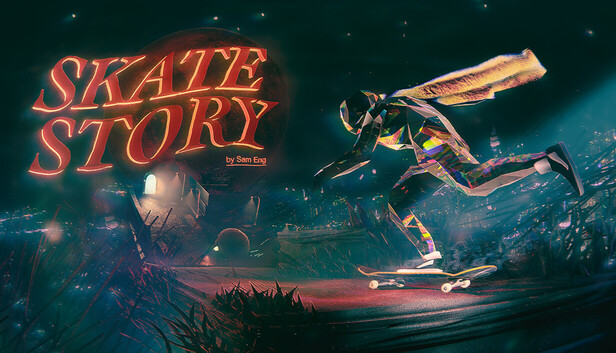
Eat the Moon, Free Yourself
In Skate Story, you’re dropped into the Underworld with a single, impossible directive from the Devil: skate to the Moon, swallow it, and perhaps earn your freedom. True, this absurdity really is the narrative baseline, and the game never once backs away from it. Layer after layer of the Underworld unfolds beneath your wheels, and each moon you metaphorically digest pulls you deeper into its cosmic labyrinth.
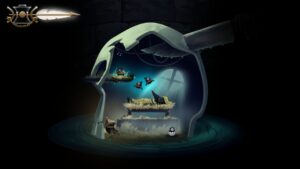
In the meanwhile, symbolic characters and objects drift in and out of your path—most of them bizarre, some oddly comforting. For instance, Rabbie, the purring rabbit who sporadically both whispers guidance and issues warnings, became one of my unlikely favorites. Others come across more as existential or societal references and critiques than as actual personalities. The early presence of an enigmatic character called the Philosopher who evaluates you and your skate moves, the thousand-legged train that serves as fast travel, and the cosmic trash bag holding an essential pass—all contribute to this surreal experience. Coupled with sporadic poetic interludes that convey more emotion than explanation, I often felt like I was interpreting a dream rather than following a plot, which I absolutely didn’t mind. The abstraction worked effectively for me, because the entire world feels hand-scrawled and allegorical, and I tried to find a deeper meaning in it.


Shattered Glass, Relentless Speed
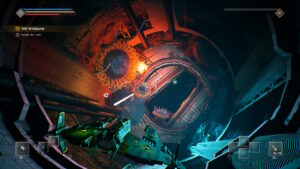
The format of progression through this weird plot is built around a sequence of short, interconnected sandbox routes, each culminating in a so-called Arch—a luminous portal that advances the story. Along the way, you navigate a plethora of hazards known as Soul Filters, which drain your vitality on contact. These can take the form of spectral flames, barbed metaphysical obstacles, elevated ramps, and other surreal geometric threats. Besides that, falling into the plants lining the edges of routes shatters you instantly, forcing a reset of the run or at least a sizable portion of it. Your demon’s glass body is fragile, leaving only a modest buffer of health before collision damage causes you to break completely.
Many of these short stages also introduce challenges that require maintaining specific speeds, performing defined trick sequences, collecting objects, or performing under time pressure. While the game is generally forgiving thanks to its rapid respawn system, certain obstacles feel unintuitive at first pass, and the solution to clearing a given hazard is not always immediately evident.
Though because of the stage layout there is no actual need for a navigational map, except in the more open spaces like the Philosopher’s Lyceum hub, the demon possesses Moon Vision, a camera-focusing ability that partially compensates for this by highlighting important objects or locations in the vicinity.


High-Speed Tricks Required
In its gameplay is where Skate Story surprised me most—not because of what it did, but how it felt. The physics lean heavily toward realism. Gaining momentum, adjusting weight distribution, chaining tricks like ollies, kickflips, heelflips, reverts, and the appropriate sounds as well—everything carries the sense of actual board weight beneath you. Then there’s also the Stomp mechanic, which finishes combos and also doubles as a combat strike, essential during the several Soul Boss encounters, mixing avoidance and timing in a very enjoyable fashion that reminded me of rhythm games more than action sequences.
In the high-speed sections, the level of physicality Skate Story offers almost becomes meditative, trance-inducing even, but that same fidelity can be punishing when obstacles tighten and reflexes have to keep up. Some routes required multiple attempts not because they were unfair, but because I simply needed time to internalize their geometry. Despite several exhilarating sections, there were moments when I felt the game wasn’t always clear about how to handle a given hazard without taking damage, so I sometimes had to resort to trial and error. Given the fast pace and the need for long-distance depth perception, sharp vision and reflexes are essential at all times during the more demanding sequences, so it’s not for those who wants to play it slow and at ease.
On a personal level, I never experienced motion sickness while playing the game, even with all its visual distortion effects in full view. On the contrary, for me, the cutscenes, rendered like spiritual hallucinations, deliver some of the game’s most memorable moments. The fisheye lean, the jittering overlays, and the subtle VHS-style wobble never pushed me out of my comfort zone. Still, I can easily imagine these layers being overwhelming for players who are sensitive to movement-heavy visuals. The game does not shy away from filters or stylistic interference, and the sensory load can be intense—so the warning at the start absolutely has merit.


Final Thoughts
Skate Story stands out as an imaginative reworking of skateboarding—less a traditional action-sports title and more a stylized descent into ritual, symbolism, and bodily precision. Its dreamlike narrative framework, cohesive universe, confident physics model, and bold audiovisual direction establish a tone that feels distinctly its own. That said, some players may find the visual intensity better suited to shorter sessions, and the recurring aesthetic motifs can make certain environments feel familiar, especially given the game’s relatively brief runtime. A handful of objectives may also test your patience through demanding inputs or opaque requirements.
Yet despite these limitations, the experience held together well for me. Skate Story remains a strange, delicate skate fable that rewards those willing to flow with its lines—offering something resonant for dedicated skaters and for players simply looking to immerse themselves in an unconventional, self-contained vision.
Additional Information
Release Date: Dec 8, 2025
Reviewed On: PC. Download code provided by developer and publisher.
Developer: Sam Eng
Publisher: Devolver Digital
Relevant links: Available on STEAM