DaRmaZat
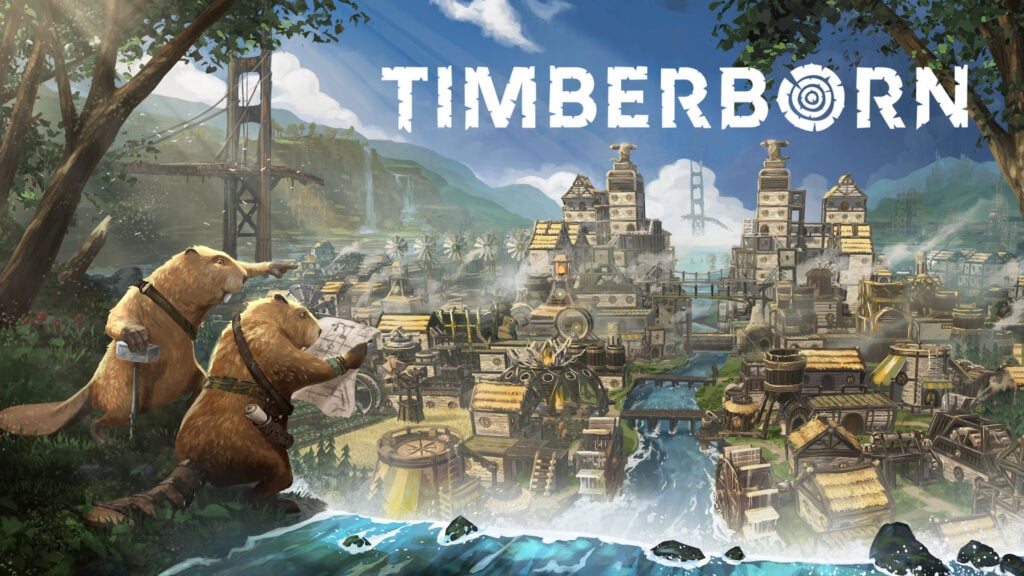
 Timberborn is, of course, no stranger to anyone who has been following the colony-building scene on Steam for a while now. With 17 official built-in maps, as well as an infinite number of downloadable maps (via Steam Workshop integration) and the ability to create your own, the options for editing existing maps, and official mod support, the possibilities and replayability of this beaver-colony-based simulator are truly limitless. After years of Early Access, version 1.0 is finally arriving. In other words, it’s high time we immersed ourselves among these workaholic rodents to see how long we can keep the colony alive.
Choose Your Faction and Cut Some Wood?
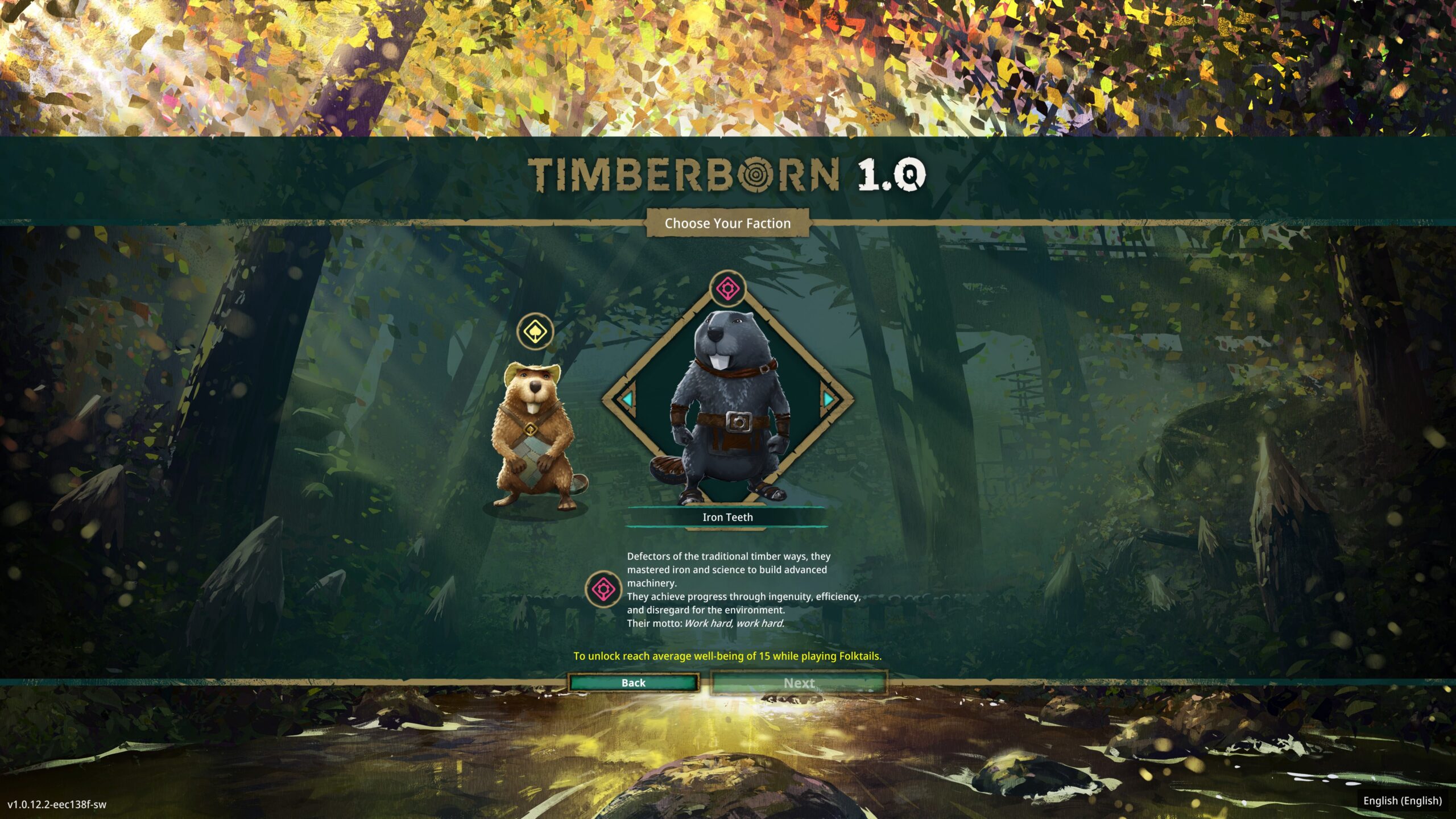
In this full release version, every playthrough gives you a choice between two beaver factions before you pick a map: the standard available, nature-friendly and hardworking Folktails, or the more ingenious, industry-driven Iron Teeth, which must be unlocked first. Each faction has unique buildings, technology, and traits, resulting in completely distinct gameplay. Additionally, there are three standard difficulty levels available, as well as the option for fully customizable parameters.
Expanding your beaver colony naturally starts with… cutting trees for logs. Wood is truly the first key resource in Timberborn. How could it be otherwise, as that’s exactly what those characteristic teeth are craving to bite? You’ll turn timber into sophisticated machinery—from water wheels and lumber mills to engines and mechanized pumps. However, as your colony evolves, you’ll find that wood alone isn’t enough; the most advanced structures require metal. To find it, you’ll need to send your scavengers to the ruins as soon as you have the opportunity.
Measure Twice, Cut Once
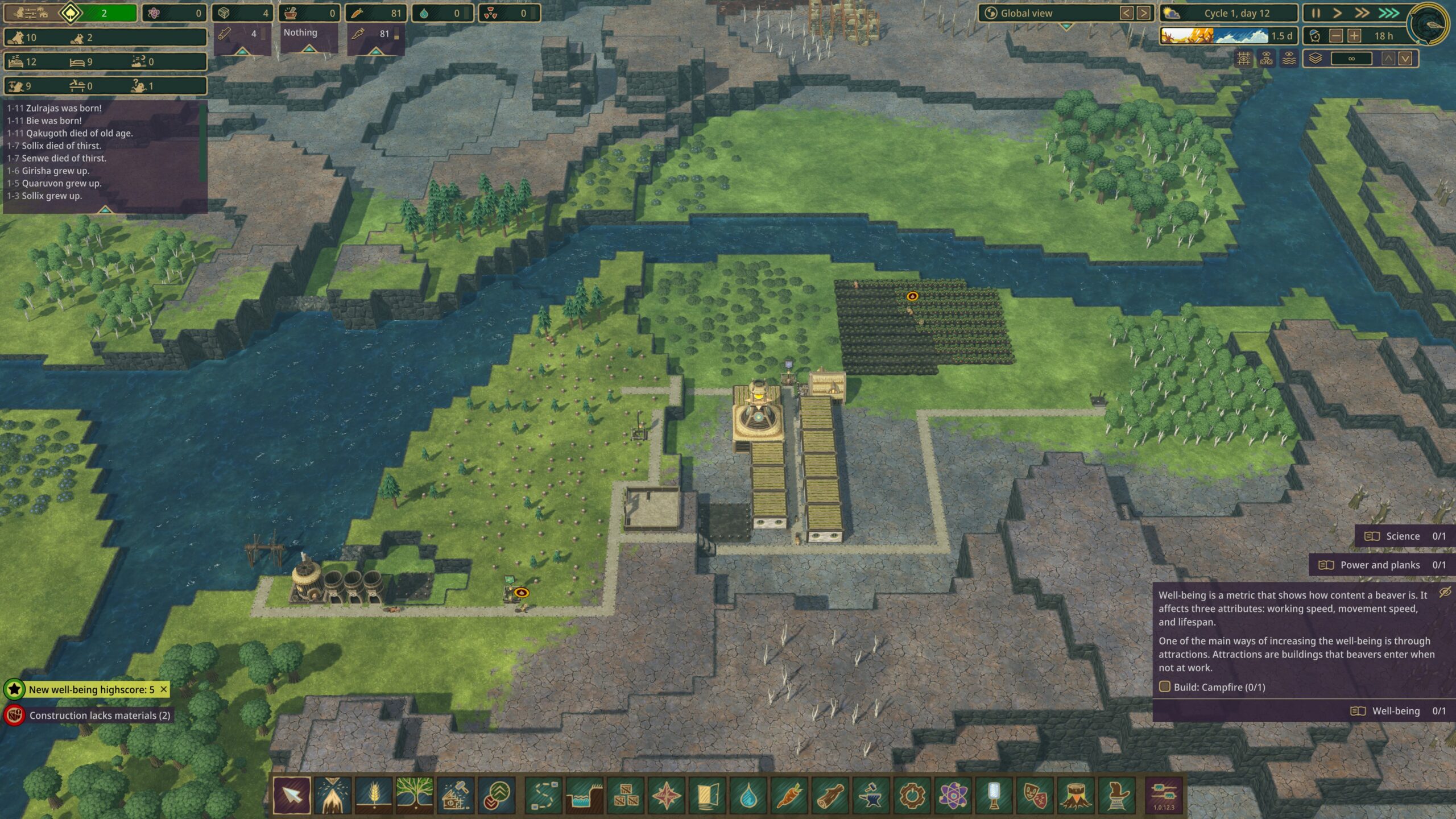
Before you can let your beavers sink their teeth into those trunks, you need to place Lumberjack Flags in forested areas near your district center(s). Since these centers always have a limited building range by default, you must extend their radius with paths to the entrance of the flags. Keep a close eye on the terrain, though, as the maps have a lot of relief. Even if a new construction looks like it’s right against the path, it might be just a bit too far back or at a different height. In those cases, you’ll need a staircase to let your beavers reach it. It’s never ideal to squeeze in full-blown stairs when space is already tight—luckily, with the 1.0 version, the new spiral staircases should help save the day.
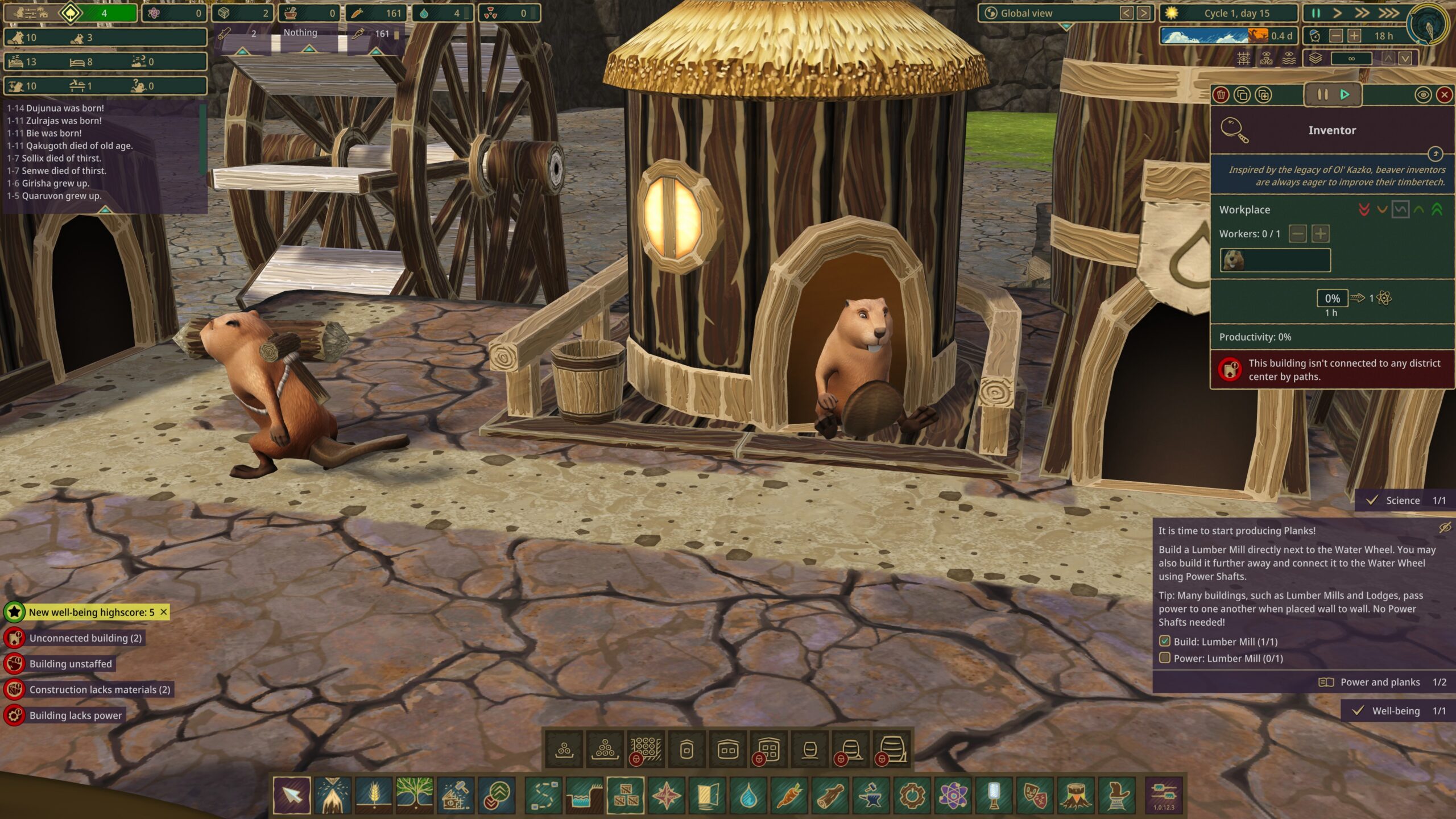
That said, layout remains everything. Placing crucial transportation-based objects too near to each other can even force you to demolish some of your constructions again, while wasting a lot of time and resources. For example, during my first game, I ran into a problem where I needed a staircase for access to my Inventor building, but I needed that very facility to generate enough Science Points to unlock the staircases in the first place!
Taming the Flow
Anyway, once you successfully place the blueprint of a construction in a good, accessible spot, you naturally still need to perform a few actions. Specifically, in the case of those Lumberjack Flags, you drag the mouse over the trees in the area you want to mark “to cut”. When interacting with similar objects that yield resources, you immediately see the benefits as well as the risks involved in picking that specific object or spot—such as chipped teeth. To its credit, Timberborn‘s controls and UI remain very intuitive, clear, and provide a good overview. For every construction, you can indicate that it should be prioritized by the haulers. After building, you can set how many workers are assigned, which resource takes priority for cultivation, and even the direction of the resource (obtain, supply-only, etc.). Of course, you also need to set up piles for storing solid resources, tanks for liquids, and warehouses for truly large quantities of materials.
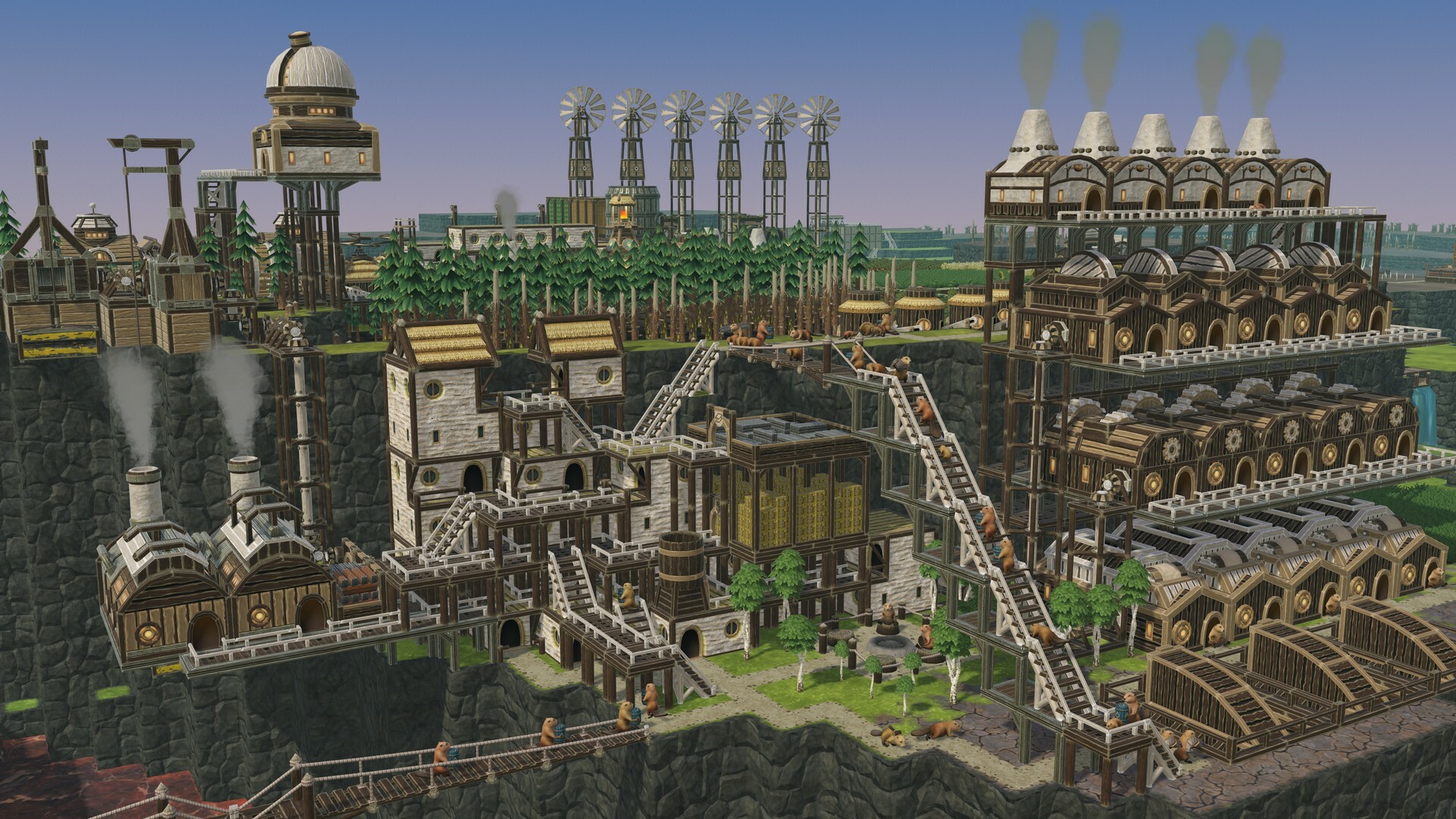
You’ll notice right away that beavers truly live for and by water; they become dehydrated after just a few minutes, so building a water pump is absolutely necessary so they can drink quickly. Water is the second key element of this game, realized through clever 3D water physics and terraforming options. Beavers’ engineering skills are legendary, and with Timberborn’s tools, yours can be too. You can put up dams and floodgates, erect massive aqueducts, dig canals and tunnels with explosives, and reshape the terrain to your liking. This full release adds even more depth here with new natural environmental features like aquifers and geothermal fields. And seeing all of this click together into a truly viable result is nothing short of wondrous. The experience of constructing intricate platforms and bridges feels rewarding, especially when integrated with a complex, well-planned power grid. It’s so cool to see it zoomed in in action!
Making a House a Home
Still, the picture isn’t complete without a place for your furry residents to rest—I haven’t even mentioned housing yet. Beaver lodges can be placed on top of each other for impressive, apartment-like constructions. Indeed, the game’s vertical architecture system is a standout feature, encouraging clever space management by allowing lodges and workshops to be stacked high.
Housing is also super relevant for their well-being and population growth. As the population grows, satisfy your evolved rodents with a balanced diet, entertainment, decorations, and end-game monuments that help restore the Earth. There are also constructions like water and power wheels for power generation, campfires for leisure, lumber mills, and Inventors to research smarter solutions to become less dependent on the environment. Eventually, you can even supercharge your colony with mechanized beavers—efficient workers who operate 24/7 and can be sent to the most hazardous areas.
Food is also essential for these cute rodents, collected via Gatherers. True to the name, you place flags where berries can be picked. However, a farmhouse is much more efficient for food supply, allowing you to plant and harvest crops like carrots, wheat, potatoes, and sunflower seeds. Meanwhile, a cycle of multiple days and nights rushes by, even at standard speed, with recurring droughts, “badtides”, or toxic waste seasons in between. The environment and climate play a major role on every map, meaning you must constantly focus on stockpiling food and keeping fields and forests alive even after rivers dry up, relying on both natural water sources and artificial irrigation to keep the land arable and your beavers safe.

Becoming a Better Engineer
This climate-driven volatility keeps things challenging and varied, you might think. But sometimes such an environmental disaster can irrevocably cause you to lose your playthrough when all the water in the area disappears, constructions stop working, and all your beavers die of dehydration. Regarding balance, especially on higher difficulties, the weather and climate mechanism can sometimes feel a bit too disruptively implemented.
That brings me right to my next point: the tutorial and explanation could certainly be structured more logically, especially for newcomers. There are a few things that won’t happen to you a second time, but they are still moments where the logic and order feel a bit off. In my case, the game only mentioned late in the tutorial that I definitely needed housing and a water pump for my population to survive. By then, many beavers had already dehydrated or died of thirst, with no offspring in sight, leaving me with a severely depleted workforce. No, it definitely wasn’t the first mistake I made, probably just like anyone else starting with Timberborn for the first time. Every detail makes a difference, and only through experience do you learn if something works and how to make it work better next time. Maybe what applies to us in life and society, applies to beavers as well?
Final Thoughts
The ingenuity of Timberborn lies in its details—from the silly gibberish noises the beavers make to learning from your mistakes and planning ahead before you get caught off guard again. Admittedly, many of the aforementioned mechanisms aren’t exactly new to the city-building genre, but the possibilities in Timberborn become gigantic as you progress, and just as impressive are the phenomenally engineered societies you can create that actually do work.
Most importantly, the fun and unique aspect of this game is that everything happens from the cute perspective of a beaver colony, with a lot of charm and an eye for detail. Just having to constantly account for their need for food, water and sleep—making sure not to push the expected working hours too high because these hardworking animals really do deserve their rest—adds so much character. Combined with the incredibly beautiful music, steadily building toward a real city and/or society feels truly relaxing. Timberborn truly succeeds in delivering a sense of satisfaction every time you add a meaningful building block to your thriving society, securing the colony’s future, one log at a time.
Additional Information
Release Date: Mar 12, 2026
Reviewed On: PC. Download code provided by the publisher and PR agency.
Developer: Mechanistry
Publisher: Mechanistry
Relevant links: Available on STEAM