DaRmaZat
 The long-awaited A.I.L.A. arrives with the weight of Pulsatrix’s debut, Fobia – St. Dinfna Hotel, and having genuinely loved that game, my anticipation only grew as more details surfaced. A dark story exploring the power and danger of artificial intelligence—flirting with themes of privacy intrusion and the blind trust we place in technology—couldn’t feel more timely. Completely my kind of thing. If everything had clicked, this could easily have been my favorite game of the year. And for a brief moment, it was… until the experience leaned too heavily into a forced Resident Evil imitation, especially in its weaker sections, and the illusion began to crack.

Into A.I.L.A.’s Dark Playground
A.I.L.A. almost immediately drops you into the near future, cast as Samuel, a gifted game tester who spends his days tinkering with high-tech gadgets from the comfort of a luxury smart apartment. One evening, SyTekk delivers its latest breakthrough—an experimental AI known as A.I.L.A., capable of launching immersive, photorealistic horror experiences. But as with any deeply immersive augmented intelligence, caution is warranted: what begins as convenience can quickly slide into intrusion, putting both your privacy and mental well-being at risk once the line between virtual and real starts to blur.
The first VR experience opens in near-total darkness, and once you escape, the camera zooms out to reveal a messy gamer’s room covered in yellow sticky notes, hinting that Samuel is just testing a game himself. The next transition drops you into his so-called Smart House—a supposedly ultramodern home filled with advanced future tech, yet shrouded in pitch-black darkness for no clear reason. What follows is a string of simple tasks: fetching drone-delivered food from the balcony, searching a cupboard for cat food, filling a cat bowl—all presented without markers or proper lighting. Even navigating the Smart House becomes a guessing game, since progress depends on wandering blindly until an invisible trigger decides you’ve touched the right object to play the next cutscene.
And yet, the arrival of the AILA Dev Kit—complete with a surprisingly elaborate installation process—stands out as one of the early highlights. When A.I.L.A. finally speaks, her voice acting lands, and even by AA standards the facial animations look impressive. Only the lip-sync breaks the illusion of perfection—perhaps I should say lip-async—but it doesn’t detract from the multiple-choice interactive flow. So far, so good. Very good, in fact.


A Digital Mind Creeping Into The Real
From there, it becomes clear that the VR sessions from the dev kit form the backbone of A.I.L.A.’s narrative structure. At first, the game struggles to offer meaning beyond shock value. There’s certainly no shortage of gore, almost always centered on physical damage and trauma. A finger needs to be sliced off. The skin on your arm must be torn open by barbed wire to grab your first weapon. And someone’s eyeball has to be pressed into a scanner to open a door. There’s also plenty of religious—perhaps even blasphemous—imagery everywhere, from crucifixes to statues of Mary that can genuinely freak you out. Of course, the more cliché-for-the-genre broken mannequins also make an appearance, lurking in the dark, sometimes even moving as if possessed. True, not every jumpscare lands perfectly, though the sound design does its best to sell each attempt—and succeeds most of the time.
After each run, when Samuel sits down with A.I.L.A. to dissect the choices made, the fears triggered, the morality selected, you can almost feel the depth in the post-experience immersion that lingers. That feedback loop defines the story more than any singular plotline, establishing an unusual dynamic in which the AI becomes increasingly present in Samuel’s real life.
Gradually, A.I.L.A.’s involvement—and perhaps even interference—in Samuel’s private life intensifies, and an eerie tension grows as the AI nudges, probes, and manipulates, breaking the neat boundary between VR sessions and Samuel’s home. It all intertwines so well, and the themes genuinely work—there’s real depth and a tangible warning about the future. Sadly, that holds only until the game pivots into a cliché extraterrestrial-invasion-and-combat-escape scenario that begins to unravel everything.


When Aliens Arrive to Ruin the Party
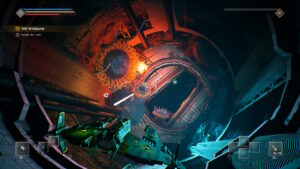
Once that alien section begins, A.I.L.A. starts—unnecessarily—mimicking Resident Evil far too much for some reason. It starts with item combining, for example mixing beverages with lily plants to create stronger drinks. The weapons follow soon after, with axes and knives for close encounters, and pistols and shotguns—of course all coming with very sparse bullets against frantic bullet-sponge enemies, if you can even defeat them. Here, the cracks and limitations in A.I.L.A. clearly begin to show, not only mechanically but also story-wise and in its lack of inspiration. The combat feels clumsy, backtracking becomes excessive, and the environment—with its very small flashlight circle, pitch-black and confusing—makes progress a chore with a lot of mandatory saving in between.
Then the most damaging decision arrives: a completely unkillable super-alien clearly inspired by Resident Evil’s tyrant Mr. X, which does not stop pursuing you and kills you in a few strikes. The creature always knows where you are, even when it shouldn’t. You can hide in closets, but the enemy pathing is so broken that it just parks itself in front of the closet, so there is no point in waiting while hiding. Killing it is also impossible; you don’t have enough bullets, and ammunition only stuns the creature for a moment.
These issues combined create something close to a softlock, especially if you explore rooms in the wrong order to solve the remaining puzzles, or have no clue what to do next with your minimal supply of items. Made worse by the irritating scare music, the tension just feels off and out of place. There’s simply too much imitation here, and for me, it made A.I.L.A. sink from an otherwise imaginative horror experience into a more generic, action-heavy, ten-in-a-dozen affair, favoring exposition over suggestion and immersion. For me, sadly, that’s how it felt.


Unreal Cyberpunk Brilliance
On the audiovisual side, however, there’s much to praise. For example, the futuristic atmosphere is breathtaking. Drones crowd the skyline to deliver meals, while new commercials constantly blast across your smart TV display, with news segments covering AI robot strikes and other future developments one might reasonably worry about.
A.I.L.A.’s lighting, assets, and reflections all showcase the clear benefits of Unreal Engine 5, Lumen, and MetaHuman tech. While the visual fidelity sits comfortably in the AA tier—with sharp, detailed, and confident level designs—some heavy frame drops can appear now and then. Never constant, but never fully gone either.

Final Thoughts
A.I.L.A. is at its most gripping when it embodies its own identity: a cyberpunk meta-horror playground composed of layered VR sessions, escalating AI involvement, surreal transitions, and a genuinely impressive futuristic world. Several sequences reach a level of creativity that few recent AA horror games attempt, and the dedication to atmosphere is undeniable.
Yet the abrupt shift toward Resident Evil-copied survival horror derailed that momentum entirely for me. The unkillable super-alien and its broken pathing, the stressful puzzles, and/or the excessive backtracking can form a perfect storm of frustration for some. What remains is a game overflowing with genius ideas, bold ambitions, and striking visual design, but equally tangled in structural flaws that slightly drag the experience down. Still, it’s a fascinating near-future nightmare, and a gripping fusion of futurism and horror.
Additional Information
Release Date: Nov 25, 2025
Reviewed On: PC. Download code provided by the publisher and PR agency.
Developer: Pulsatrix Studios
Publisher: Fireshine Games
Website: A.I.L.A.
Relevant links: A.I.L.A. on STEAM