DaRmaZat
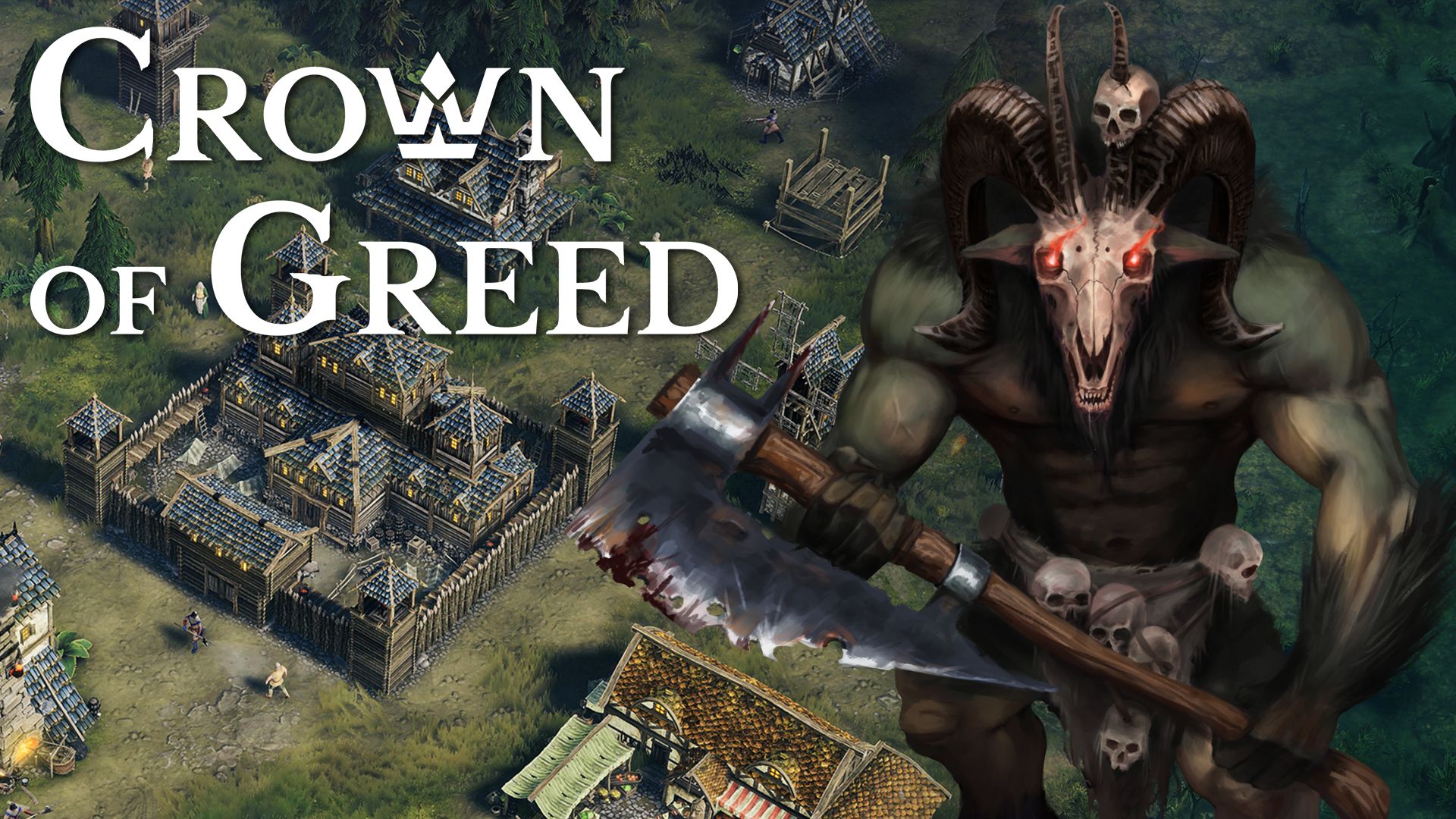
 It is often said that heavy is the head that wears the crown, but in Crown of Greed, the weight is compounded by the fact that absolutely nobody listens to you. Inspired by the cult classic Majesty, this fantasy RTS from BLUM Entertainment throws out the standard playbook of direct unit control. Forget about clicking a soldier and telling them where to stand; here, the coin is king, and your subjects have wills, fears, and price tags of their own. Claiming the throne of Rodovia means mastering the art of indirect influence, skillfully bending chaotic heroes to your will through bribes and bounties rather than divine right.
Navigating The Rules Of Rodovia
When starting the Crown of Greed‘s campaign, you are faced with a choice: jump in headfirst or follow the tutorial. My advice is to start with the advisor. The gameplay is not particularly intuitive, as it is governed by a dense web of rules and mechanics that govern how your subjects behave. Constant events trigger across the map, and having that extra bit of voiced guidance is a godsend when the kingdom starts to spiral. Notably, all story and tutorial elements are fully voiced, which greatly helps in digesting the constant stream of information. You step into the shoes of “His Highness” in the realm of Rodovia, a kingdom struck by malevolent ancient powers, resurging curses, and an ever-growing number of dangerous monsters disrupting any remaining sense of order. Your goal is to rebuild the kingdom, hiring heroes to push back the encroaching darkness before the entire realm falls to ruin.
Each mission is presented via icons on the campaign map, where you progress through scenarios that effectively function as chapters. These scenarios not only expand the backstory, but also introduce new mechanics, enemies, and opportunities. Every scenario consists of a main objective alongside optional side missions, which reward additional resources and significantly more Heritage Points when completed on higher difficulty levels.

The Art Of The Contract
Since you cannot issue direct orders, heroes are the lifeblood of your strategy. Recruiting them is your top priority, though it takes a moment to figure out how to actually get them onto the streets. I quickly found that the key to success lies in structures like the Hunter’s Camp, which are essential for recruiting heroes. Without heroes, you are effectively defenseless. Once recruited, these champions act on their own initiative based on randomized traits—you might get a devout warrior who hates the undead but has the stamina of a wet paper towel.
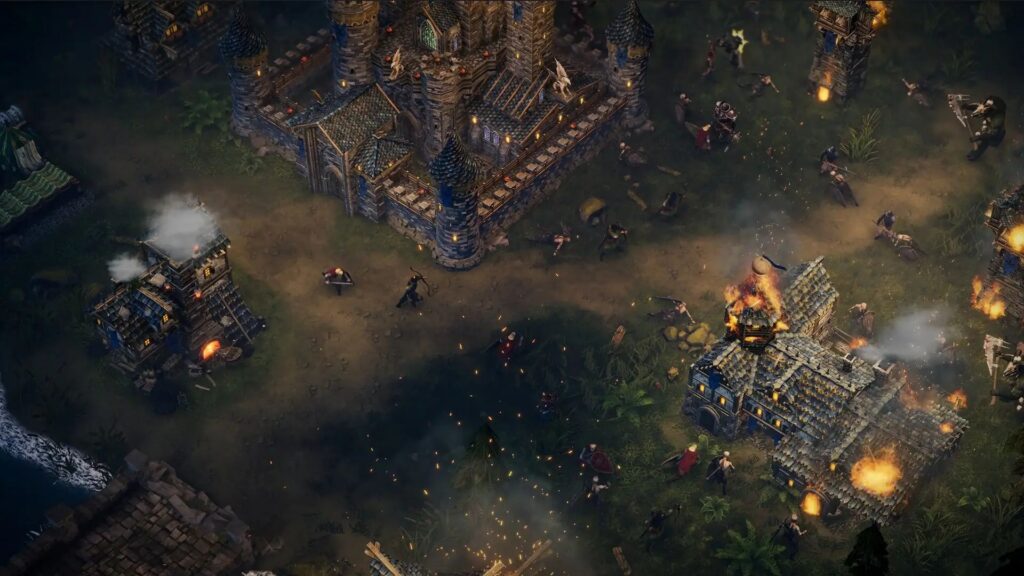
You can continuously monitor your subordinates, who are divided into workers, guards, tax collectors, and heroes, each fulfilling their own role within the kingdom’s ecosystem. Heroes themselves level up, gain experience, and improve their equipment, attributes, and traits over time, often purchasing items from locations such as the forge, marketplace, or alchemist’s shop.
To get them to actually do something, you must place contract flags. Want a monster den cleared? Set an attack bounty. Need a ruin explored? Post a reward. You can even double-click a building to set an instant defense contract. Contracts can be adjusted or relocated freely, and you may even pay out rewards early to encourage heroes to maintain their position. It’s a fascinating concept, to say the least, where you are less of a general and more of a glorified accountant, dangling gold to ensure their chaotic natures align with your royal goals.
Managing the Medieval Machine
The campaign map is dotted with icons representing scenarios that act as chapters. Completing these earns you Heritage Points, which are essential for permanent kingdom upgrades between missions. These scenarios serve a dual purpose: they flesh out the gloomy, Slavic-inspired backstory and introduce new mechanics or enemies.
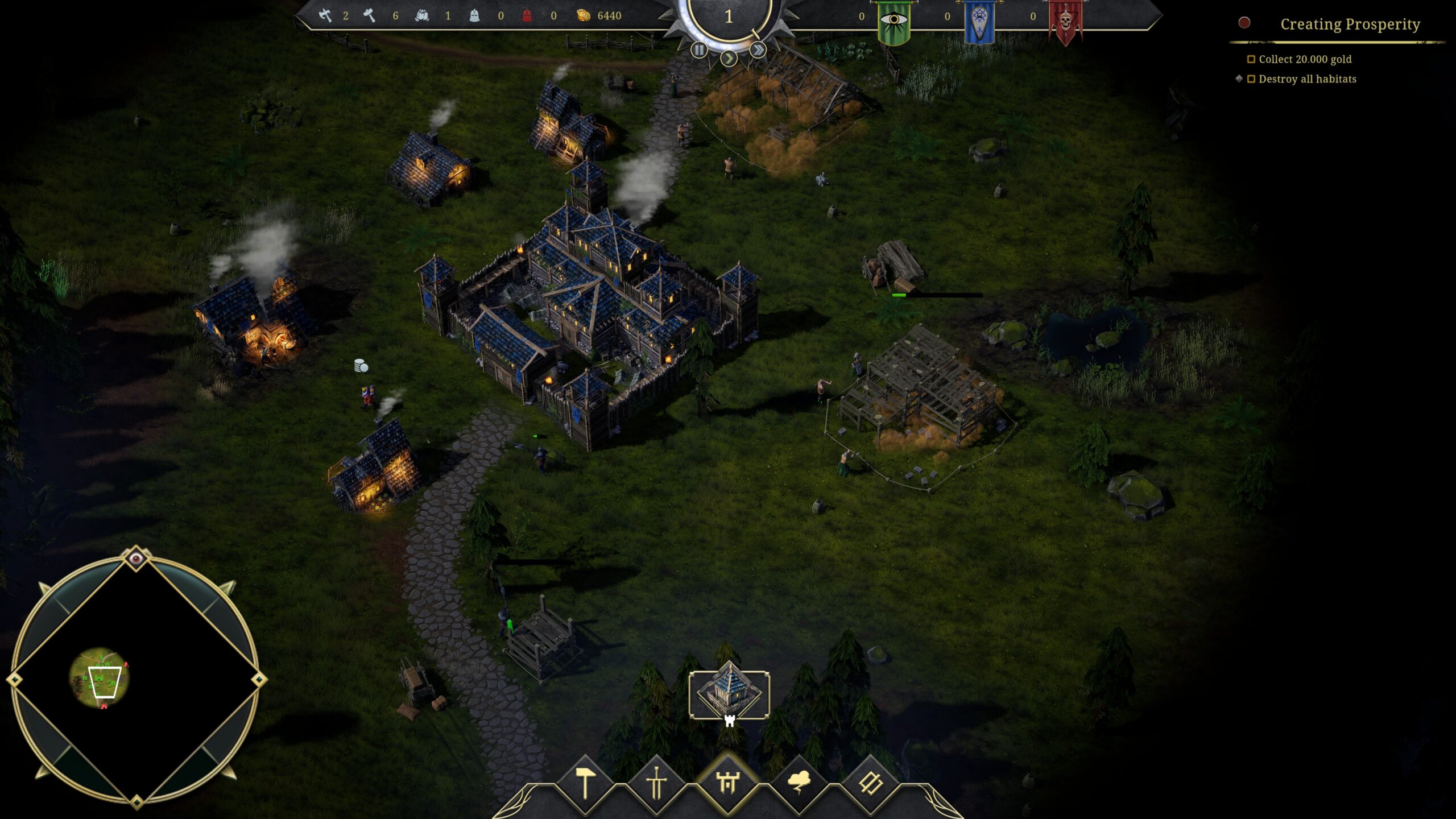
At the heart of each mission lies your kingdom management, where buildings are divided into three categories: economic structures that drive prosperity, headquarters that enable hero recruitment and development, and defensive buildings that protect your realm. These can be constructed and upgraded using Heritage Points, unlocking new features, improving your economy, and strengthening your defenses.
Gold is your most important resource, used for construction, upgrades, research, recruitment, spells, and contracts. Your tax collectors gather gold from buildings such as marketplaces, taverns, and other facilities, delivering it safely back to the castle or guard towers. The castle itself is the heart of your city and its loss results in immediate failure, making its protection paramount.
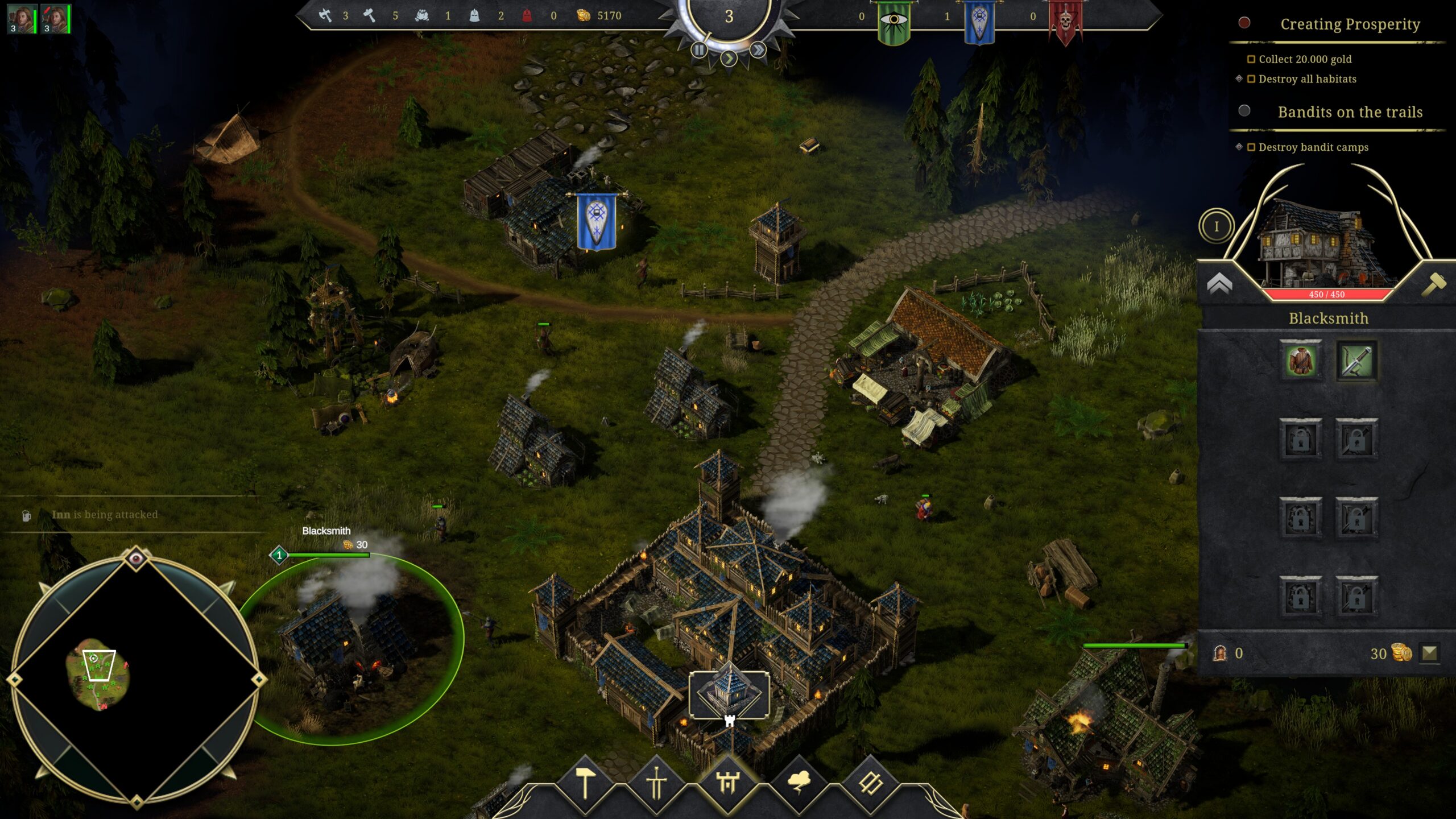
Certain buildings unlock automatically as your settlement expands, while others—like trading posts—can be placed strategically across the map to boost your income through commerce with other regions. Facilities such as the inn allow heroes to rest, increasing their effectiveness, while blacksmiths improve their gear. Also handy is the ability to prioritize construction or repairs, though of course, this is a genre standard that is pretty much expected by default today.
Kingdom Come: Overwhelmed
What truly won me over is how the dark, atmospheric setting comes to life by a hauntingly beautiful soundtrack composed by Polish artists, perfectly capturing the gloomy essence of European medieval folklore. However, while Crown of Greed‘s concept remains brilliant, the pacing often feels like it’s galloping away from you. You might be fending off ghostly wolves and bears while simultaneously trying to set up defenses and scouting contracts for bandit camps. At the same time, monsters continuously pour out of lairs until you destroy the source, forcing you into a state of constant reactive play.
Currently, the RTS is definitely not for beginners, largely due to a lack of granular configuration. There is a pause button, but you can’t do much with it, and the game lacks a custom speed slider or adjustable gameplay parameters. The day-and-night cycle further complicates matters, as certain enemies and hero traits become stronger depending on the time, yet there is no clear visual clock or timeline indicator to track these changes.
Furthermore, when an advisor warns you of an immediate threat, it’s often a purely dialogue-based cue. I found myself manually scouring the map because the UI didn’t clearly ping the location of the crisis, which is frustrating when time is a resource you can’t afford to waste. With so many simultaneous threats—ranging from bandits exploiting trade routes to increasingly aggressive monster attacks—the experience can feel overwhelming, especially without clearer visual guidance on the minimap.
Final Thoughts
Crown of Greed is a unique take on “kingdom management meets RTS” that rewards those who enjoy the specific “indirect rule” niche. The heritage system provides a satisfying sense of long-term progression, and the fully voiced tutorial is essential for navigating the game’s steep learning curve. However, there is clearly still room for growth. The absence of a custom speed slider or more distinct visual pings on the mini-map makes managing the chaos harder than it needs to be.
The real challenge isn’t just the difficulty, but the lopsided tug-of-war between maintaining internal defenses and the constant pressure for external expansion. If you can stomach a treasury that drains as fast as your heroes are swamped by roaming threats, there is a deep, rewarding empire-builder hidden beneath the frantic pacing. It’s a solid foundation that just needs a bit more balance to truly let its royal potential shine.
Additional Information
Release Date: Mar 31, 2026
Reviewed On: PC. Download code provided by the publisher and PR agency.
Developer: BLUM Entertainment
Publisher: PlayWay S.A., ConsoleWay
Official Website: Blum Entertainment
Relevant links: Available on STEAM